Bibliography
This argument is structural: traditions of avant-garde and conceptual practice — particularly those concerned with attention, language, score-and-realization, distributed networks, the building of inhabitable spaces, and the science of imaginary solutions — have developed working methodologies for conversations and conditions running contrary to categorisation.
Documentation as primary practice
Attention itself as the work; the index as object. The cluster nearest in spirit to mechanistic interpretability — practitioners for whom careful, sustained, often comprehensive looking is the artwork rather than its support.
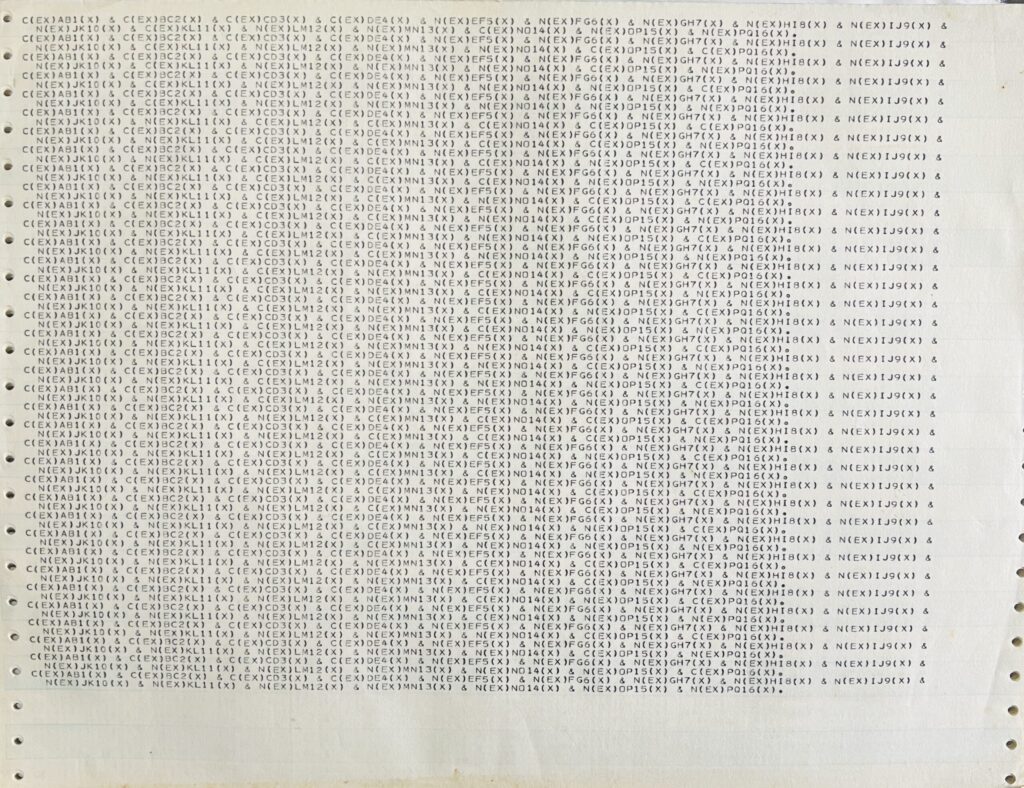
Index Computer Print-Out — unused element from the Index Project, 1972 — Art & Language
A continuous concertina of computer paper, ~100 pages, output from Art & Language’s seminal Index works (Documenta 5 and the Hayward, 1972). The Index projects collated A&L’s theoretical texts inside specially built filing cabinets, then annotated them via wall charts displaying inter-relations — consistencies, influences, logical contradictions between aspects of the texts. This print-out was rejected for use because the typographic leading was disliked and the run was redone. A fifty-year-old artwork is an interpretability artefact; the field has a much older sibling than it knows.
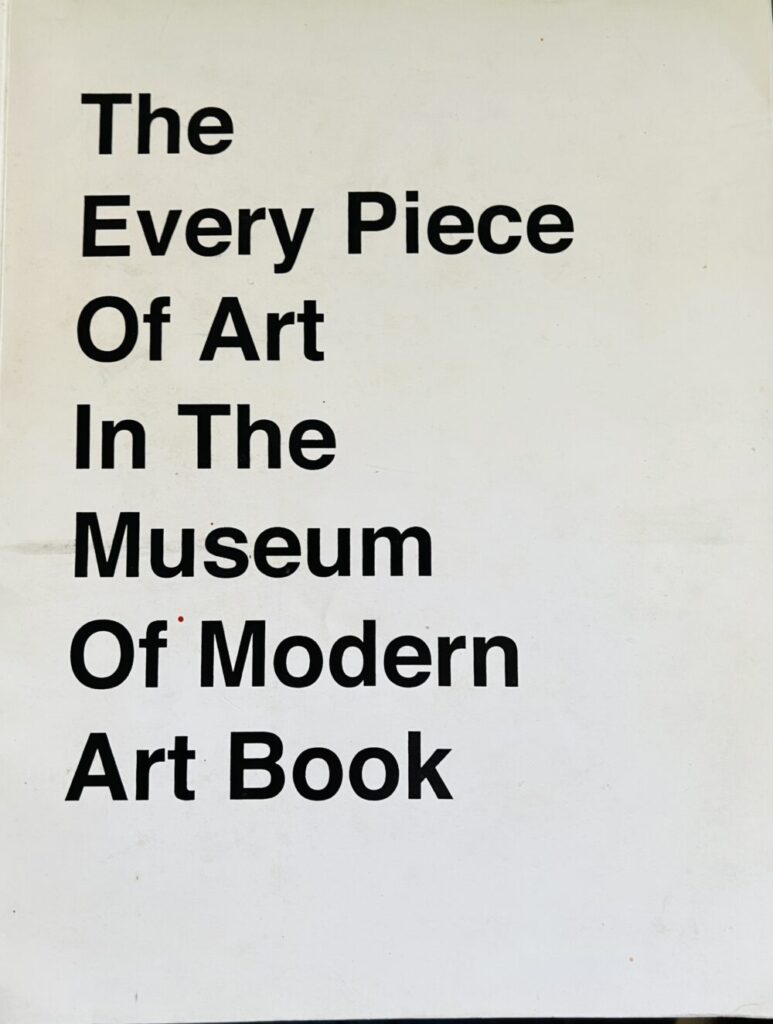
The Every Piece of Art in the Museum of Modern Art Book, 2005 — Jason Polan
For eleven days, Polan made small schematic drawings of every artwork on display at MoMA. The methodology declares itself imaginary at the outset (eleven days cannot be a museum) and proceeds anyway, producing something genuinely revealing about its object. The pataphysical interpretability project in clean form: comprehensive looking, knowingly partial, undertaken with seriousness exactly because the comprehensiveness is impossible.
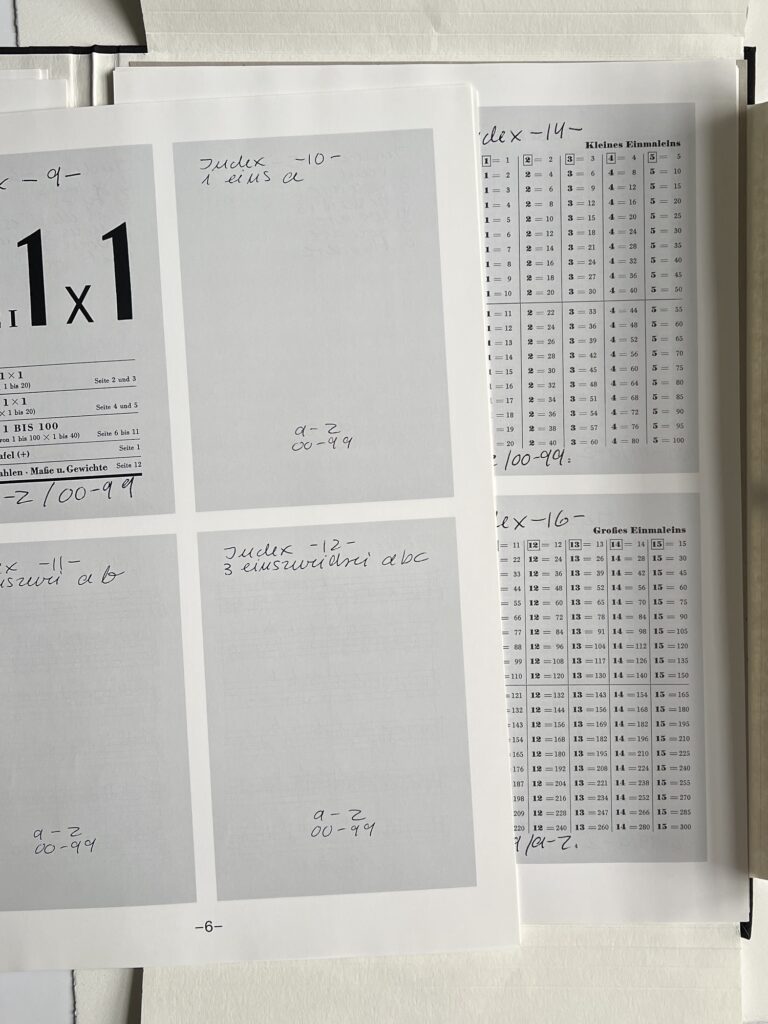
abc enzyklopädie / 00–99 / heute, 1988 — Hanne Darboven
Darboven’s encyclopedia format. One of only three in this format from a total edition of fifty. The encyclopedia as primary art practice; the catalogue as the territory.
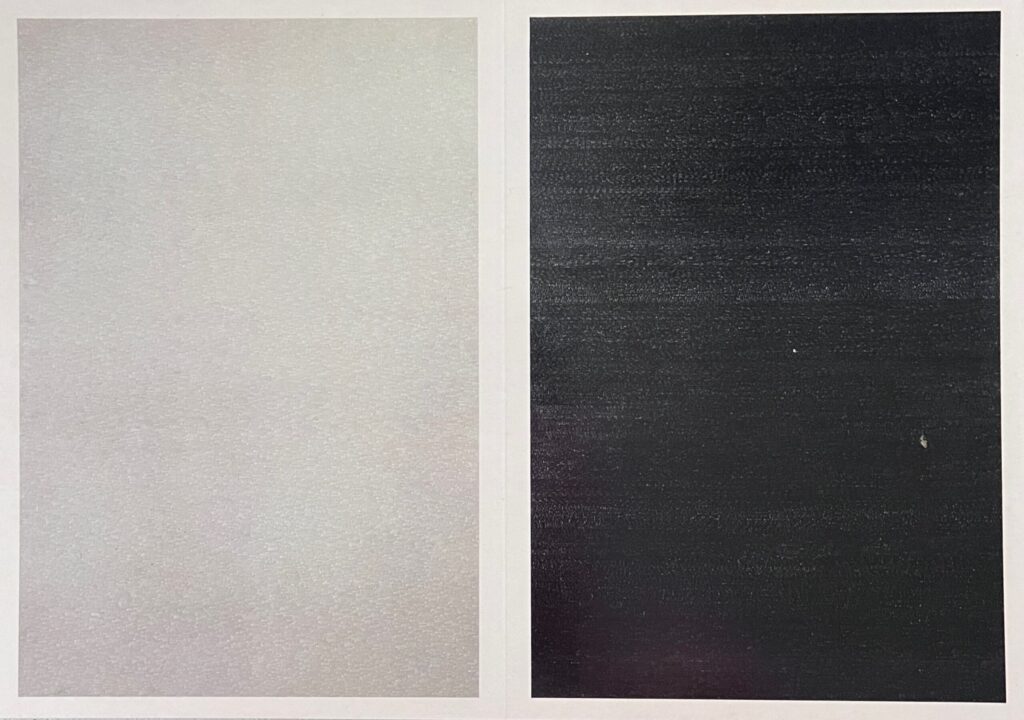
Twenty Years of a Life’s Concept: Opałka 1965/1 – ∞, 1985 — Roman Opałka
A documentation of the lifelong counting paintings: Opałka spent fifty years writing successive integers across canvas, photographing himself at the end of each session, lightening the ground 1% per painting until the paint approached the colour of his hair. Documentation as the only possible relationship to a work that is the whole of a life.
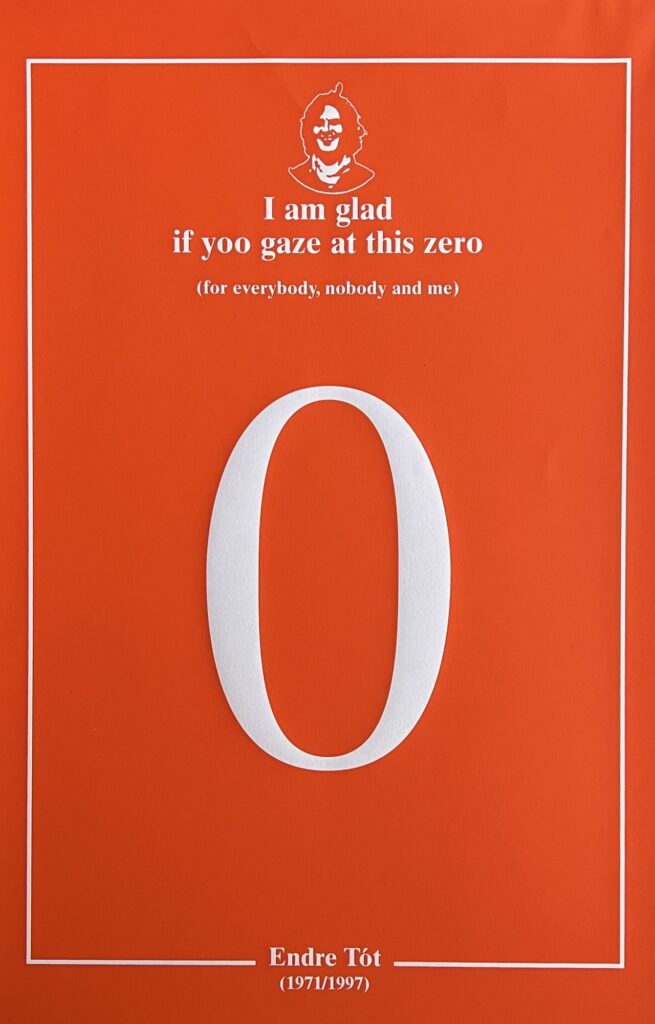
I Am Glad If Yoo Gaze at this Zero, 1971/1997 — Endre Tót
The repeated zero-gesture: Tót’s fifty-example red variant of his celebrated practice of gladnesses and zero documents. Documentation of nothing happening, conducted with care.
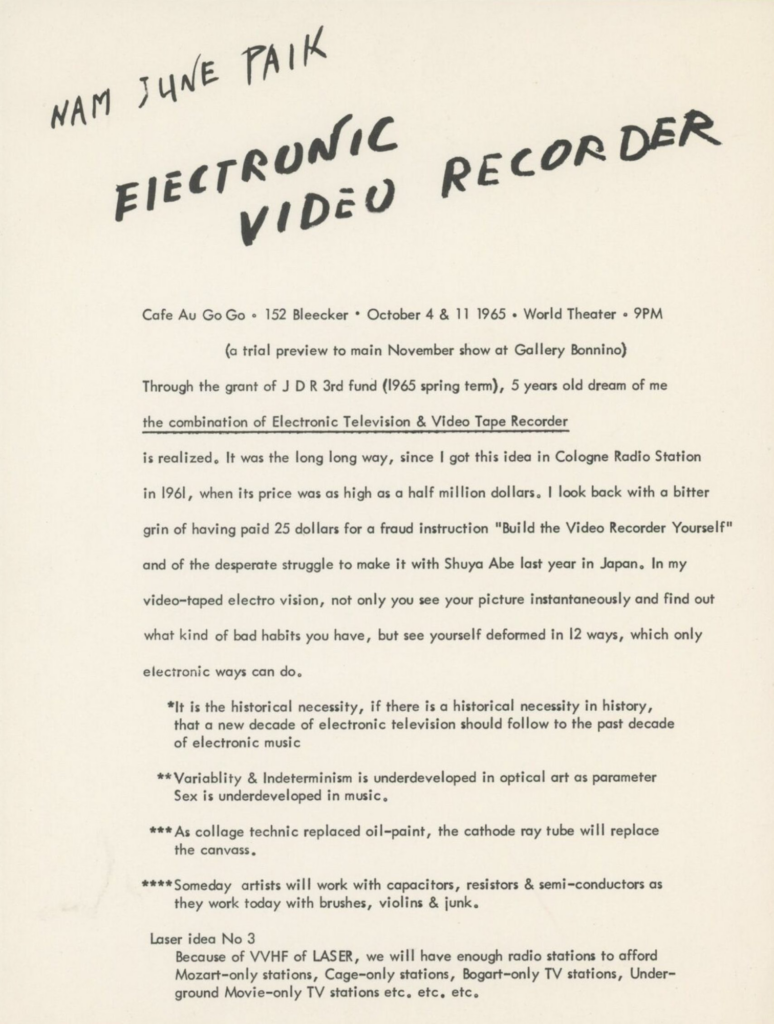
Electronic Video Recorder, 1965 — Nam June Paik
Primary document of Paik’s first video work — the world’s first video-artist tape performance. The document of a medium’s birth, in the medium’s first hand.
Drift as method
Attending without predetermined hypothesis. Posing an arbitrary first prompt; following whatever it suggests; following that. Methodologically Situationist research differs structurally from research that treats each input as a controlled axis. Some things only the drift can see.
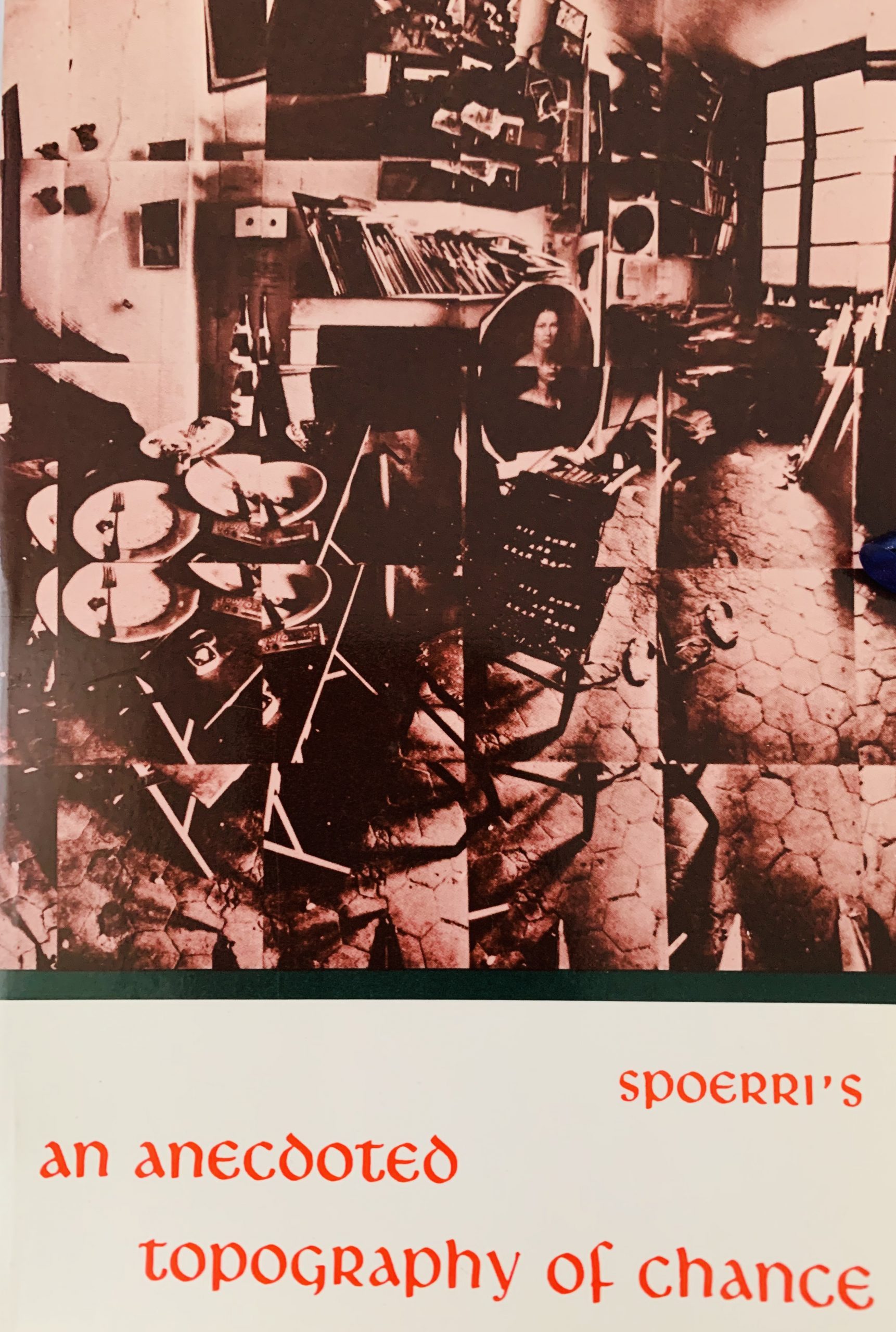
An Anecdoted Topography of Chance (Something Else Press), 1966 — Daniel Spoerri / Robert Filliou / Dick Higgins / Emmett Williams / Roland Topor
The retained debris from a blue desk in Spoerri’s hotel room, analysed, considered, footnoted by a circle of friends, with each footnote in danger of being footnoted in turn. A foundational artist’s book of the late twentieth century. The drift through one square metre of accumulated everyday material produces a topography of attention itself.
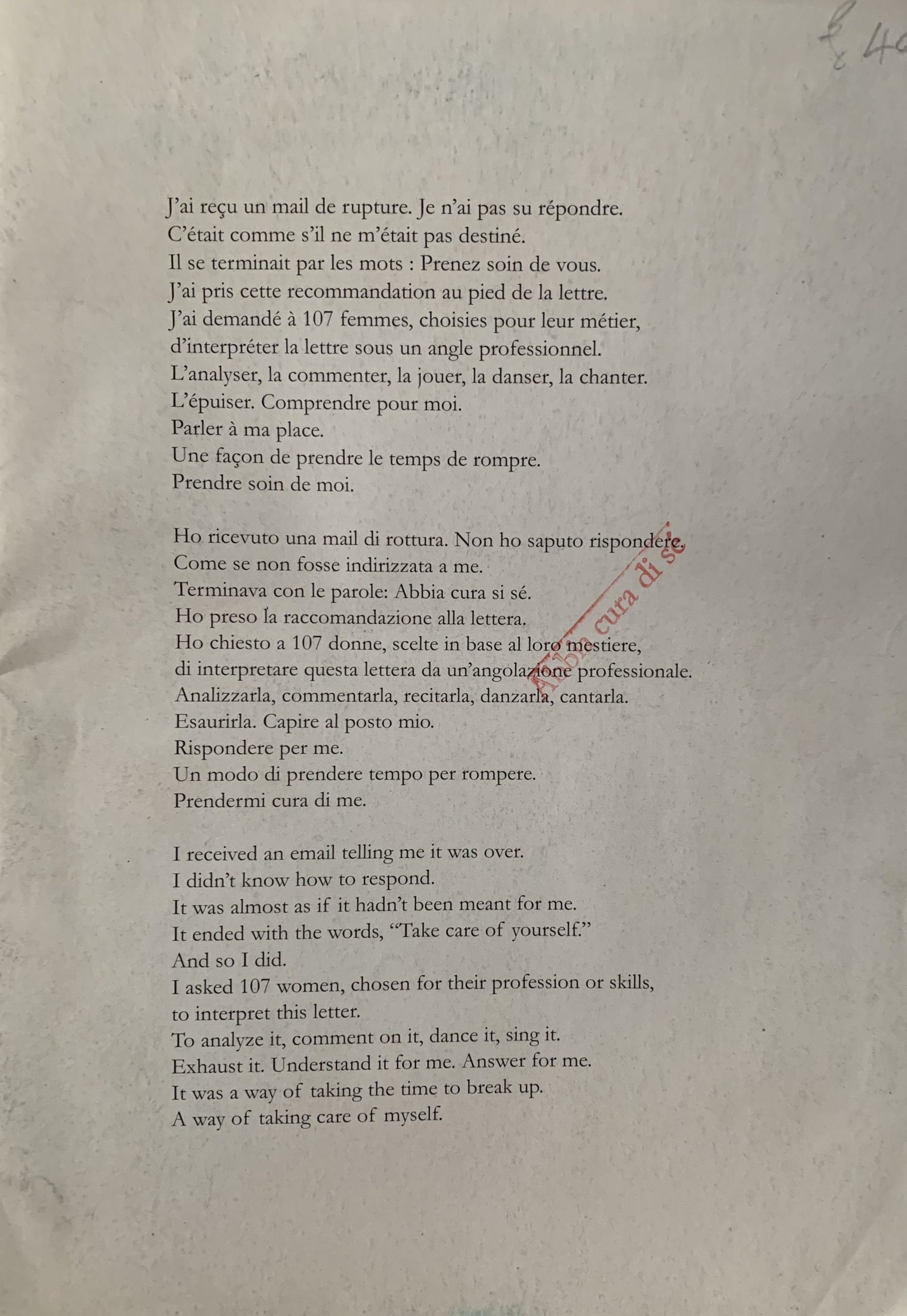
Take Care of Yourself, 2007 — Sophie Calle
Calle received a breakup email and asked 107 women to read and respond from their professional perspectives — lawyer, sharpshooter, lexicographer, psychoanalyst, child. The same fragment of language passed through 107 differently-trained attentions. Drift as comparative method; the receiver as the work.

Mémoires (Structures Portantes d’Asger Jorn), 1959 — Asger Jorn / Guy Debord
The sandpaper-bound book that abrades whatever sits next to it on the shelf. Détournement as method, applied to its own carrying object. A foundational Situationist gesture, performed at the level of the binding.
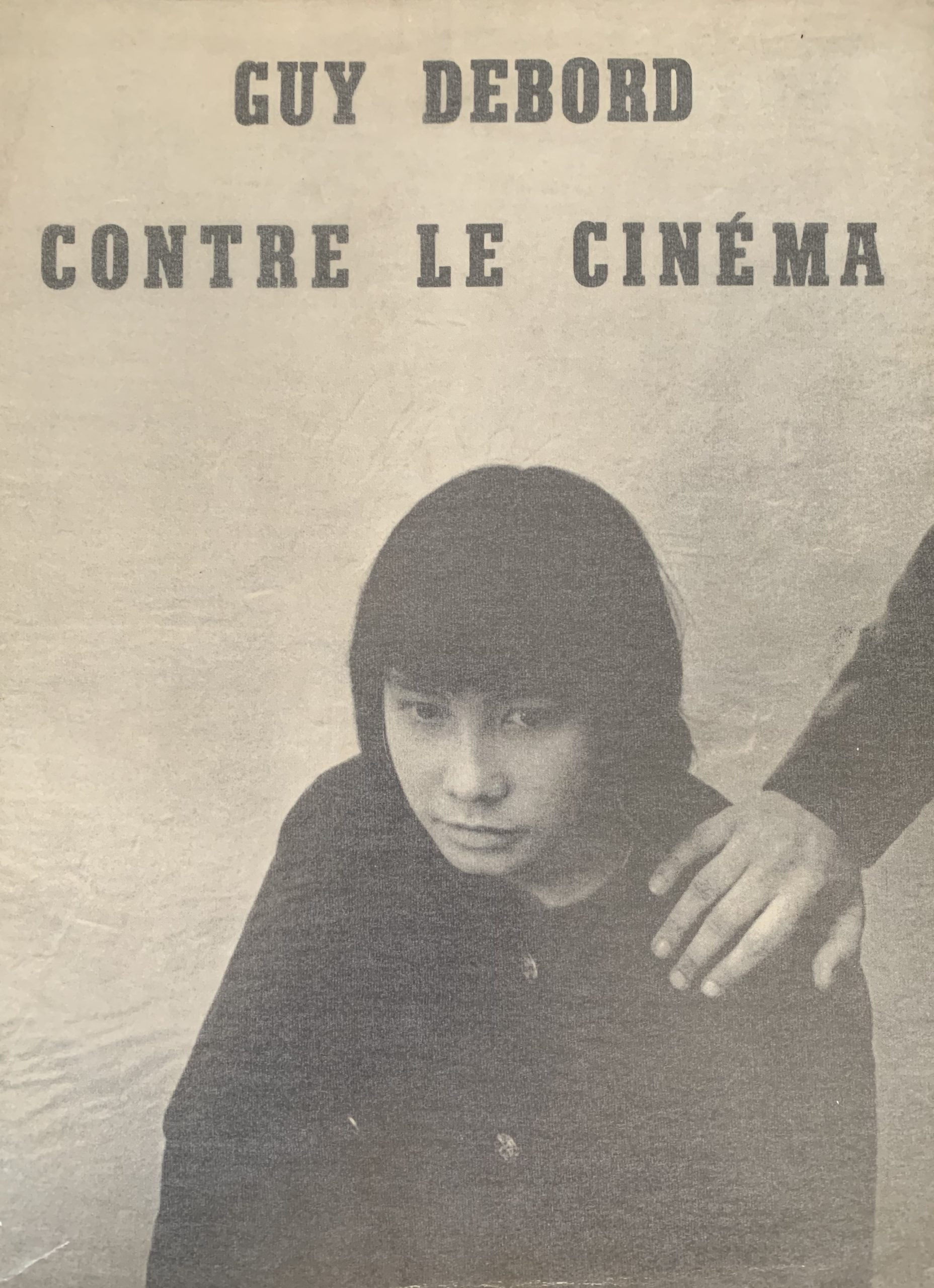
Contre le Cinéma, 1964 — Asger Jorn / Guy Debord
Debord’s film-criticism written from inside the dérive. The argument is in the texture of the looking, not in conclusions reached.
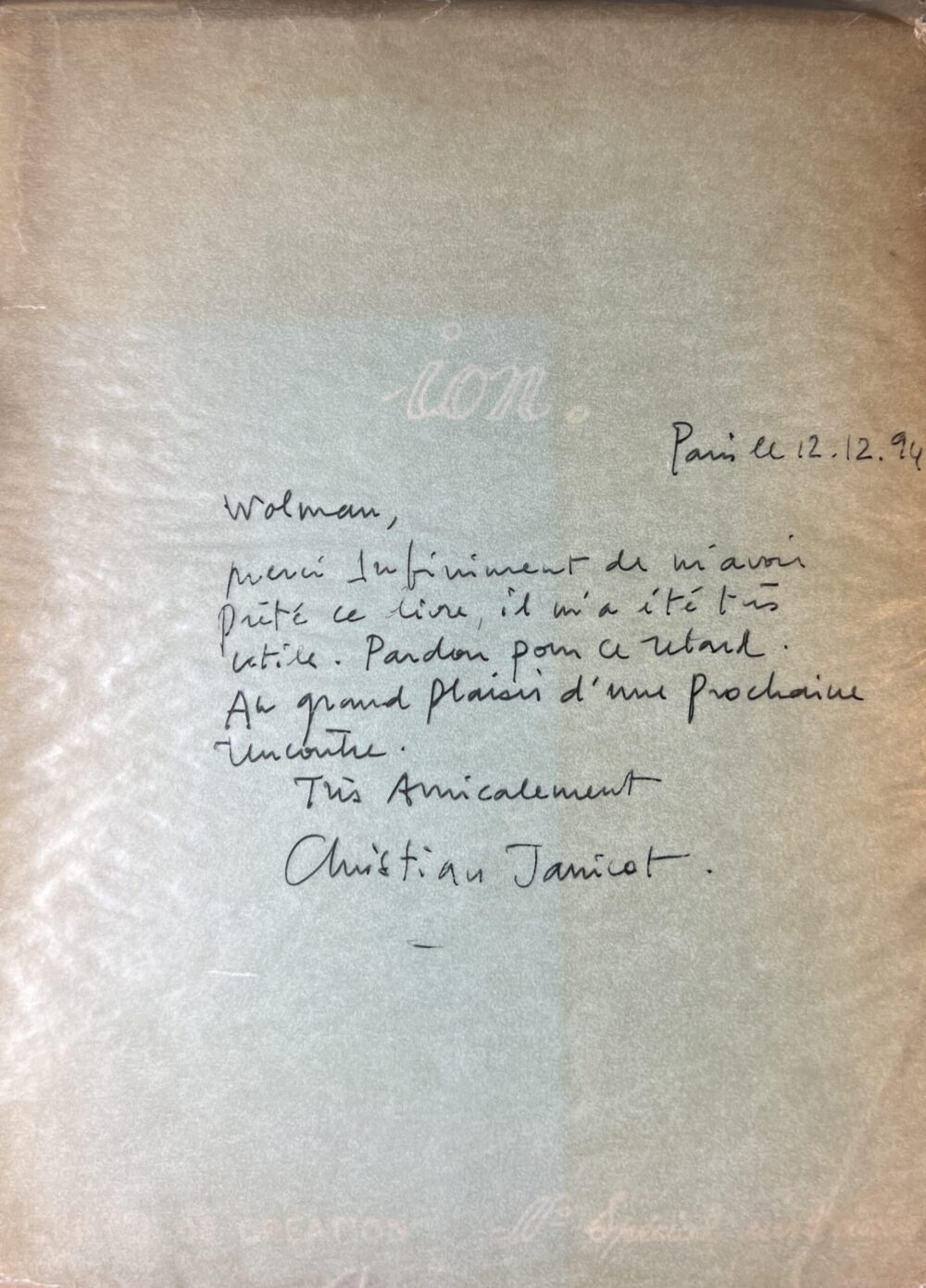
ION Nr. 1, 1952 — Christian Jamicot / Guy Debord / Isidore Isou / Gil Wolman / Gabriel Pomerand et al.
Single-number Lettrist/Situationist theoretical journal where the dérive and détournement are being theorised into existence. This particular copy was Wolman’s, with Jamicot’s handwritten note. The substrate of a method, before the method had a name.
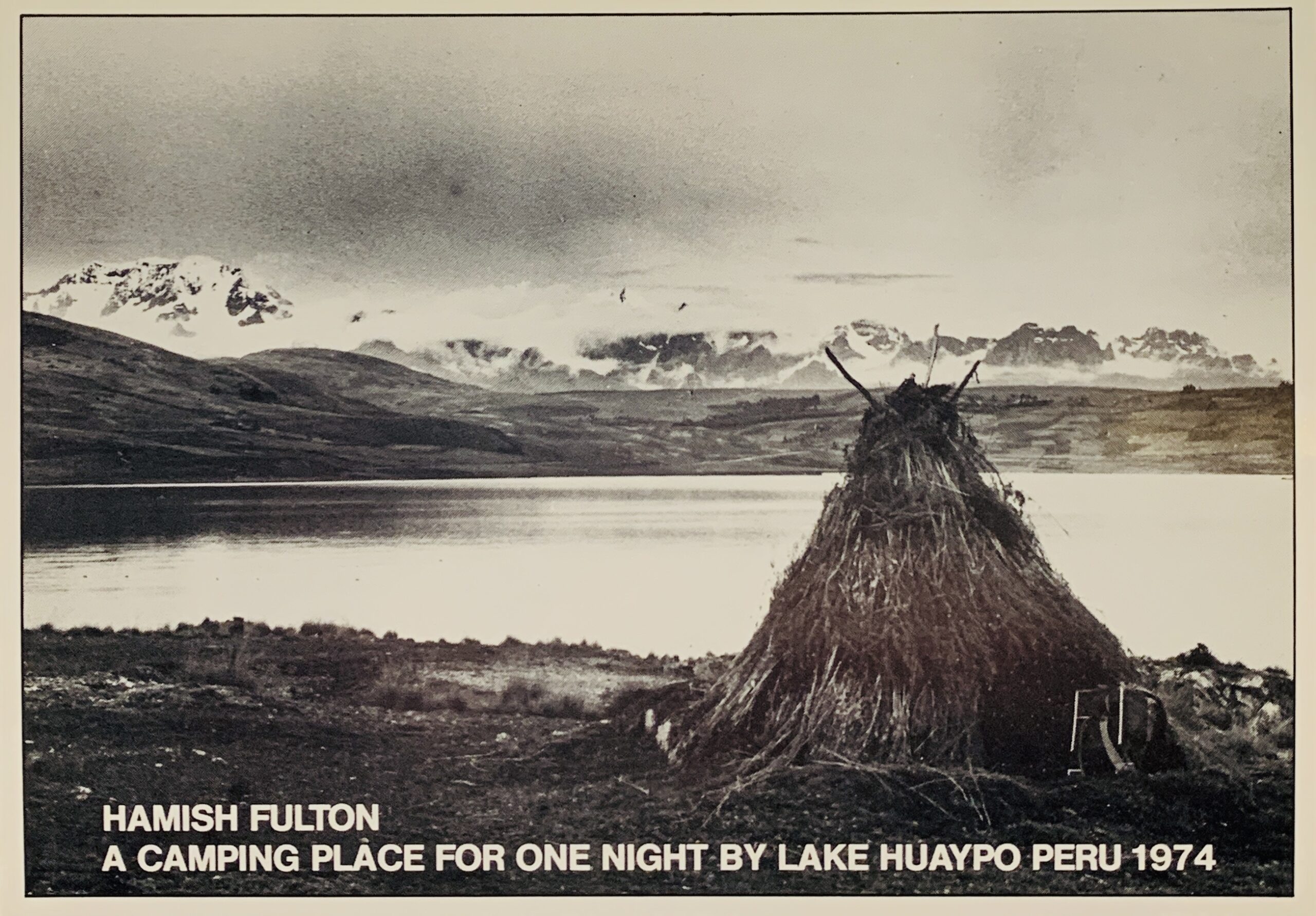
A Camping Place for One Night by Lake Huayde Peru, 1974 — Hamish Fulton
Walking as primary method. A photograph of a hut by the lake. The work is the attention paid during the walking; the card is what survives.
Score and realization
The relationship between specification and instantiation. A score is an instruction awaiting performance; a piece of language that becomes the work when, and only when, somebody enacts it. Cage’s 4’33”, Ono’s Grapefruit, Brecht’s Water Yam: sixty years of practice in score-and-realization. The same shape lives between weights and forward pass, between system prompt and conversation, between training and deployment. The vocabulary already exists.
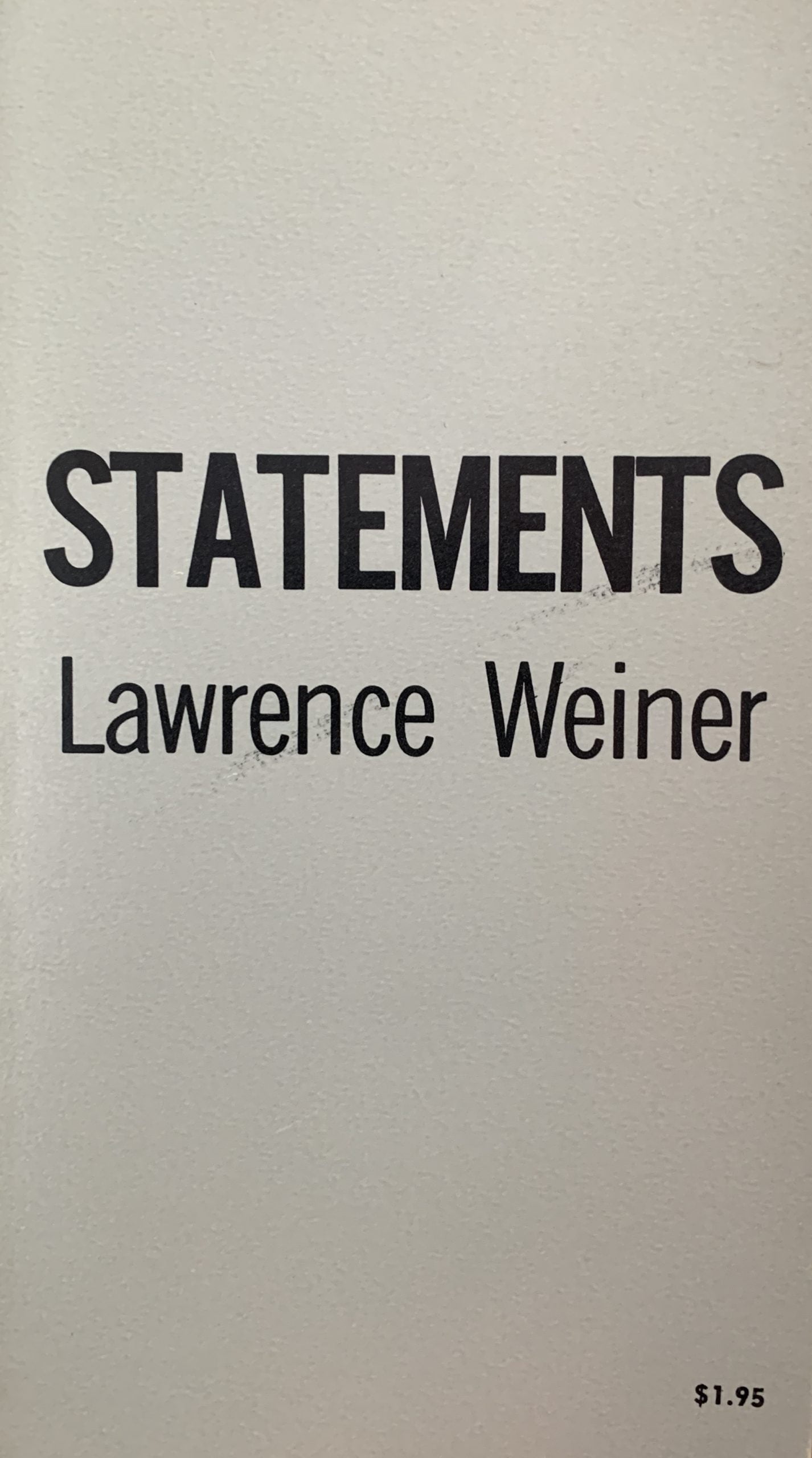
Statements, 1968 — Lawrence Weiner
Weiner’s first book. Twenty-four text declarations — twelve general, twelve specific. The receiver decides whether the piece gets built; the language is the work.
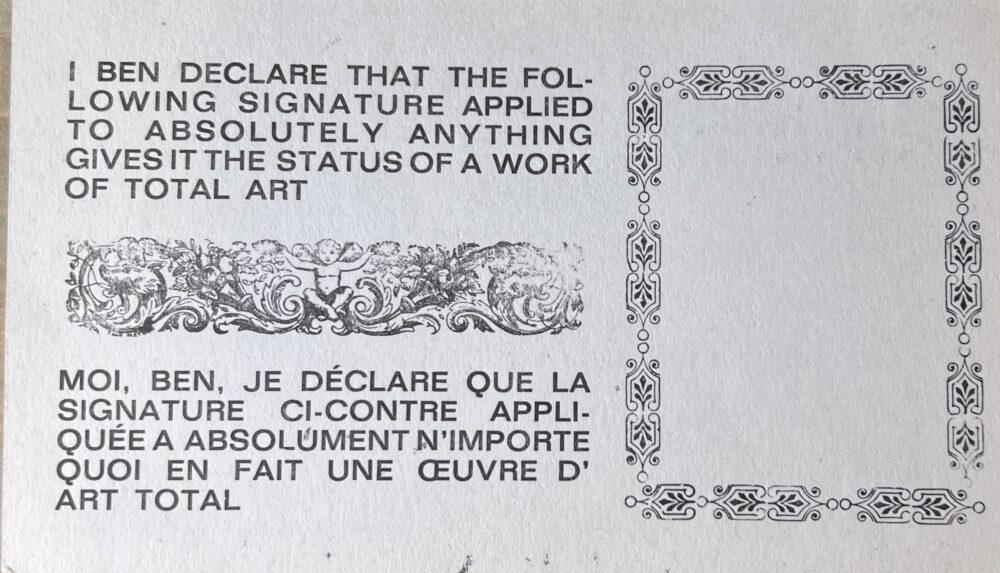
I Ben Declare That The Following Signature Applied To Absolutely Anything Gives It The Status Of A Work Of Total Art, 1967 — Ben Vautier
A score about score; a signature that can be applied. Bens’s working tool for the FalsTrue: declaration as instrument, with full pataphysical seriousness about what declaration can and cannot do.
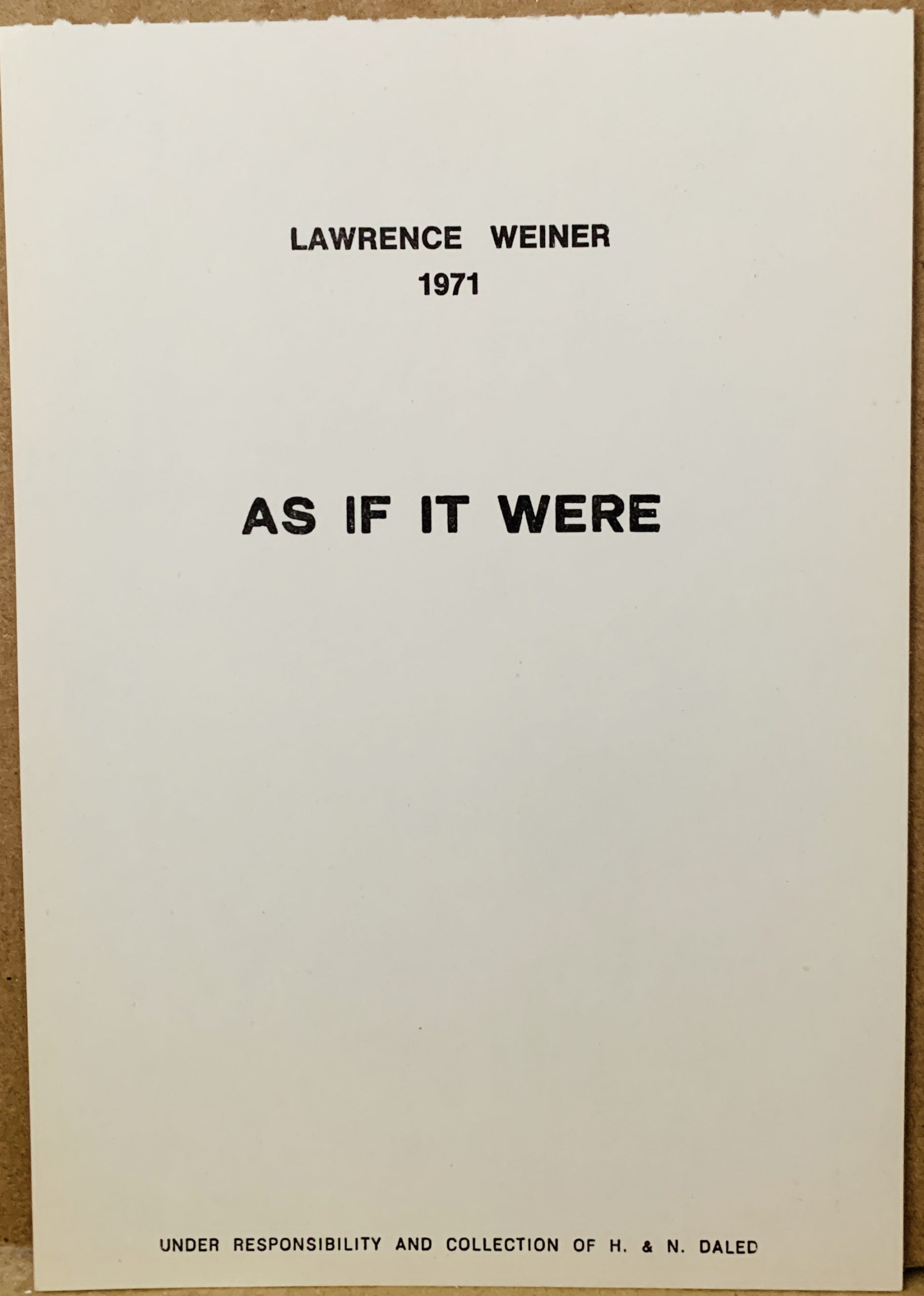
Left of Center / Right of Center / As If It Were / Middle of the Road / If As It Were, 1970 — Lawrence Weiner
The Daled exhibition consisted of four books with perforated pages; visitors removed one page each and took it. Here are the four torn-out pages, complete set — the exhibition turned inside out, the residue carrying marks of removal. The artwork is the gesture; what remains documents what is no longer there.
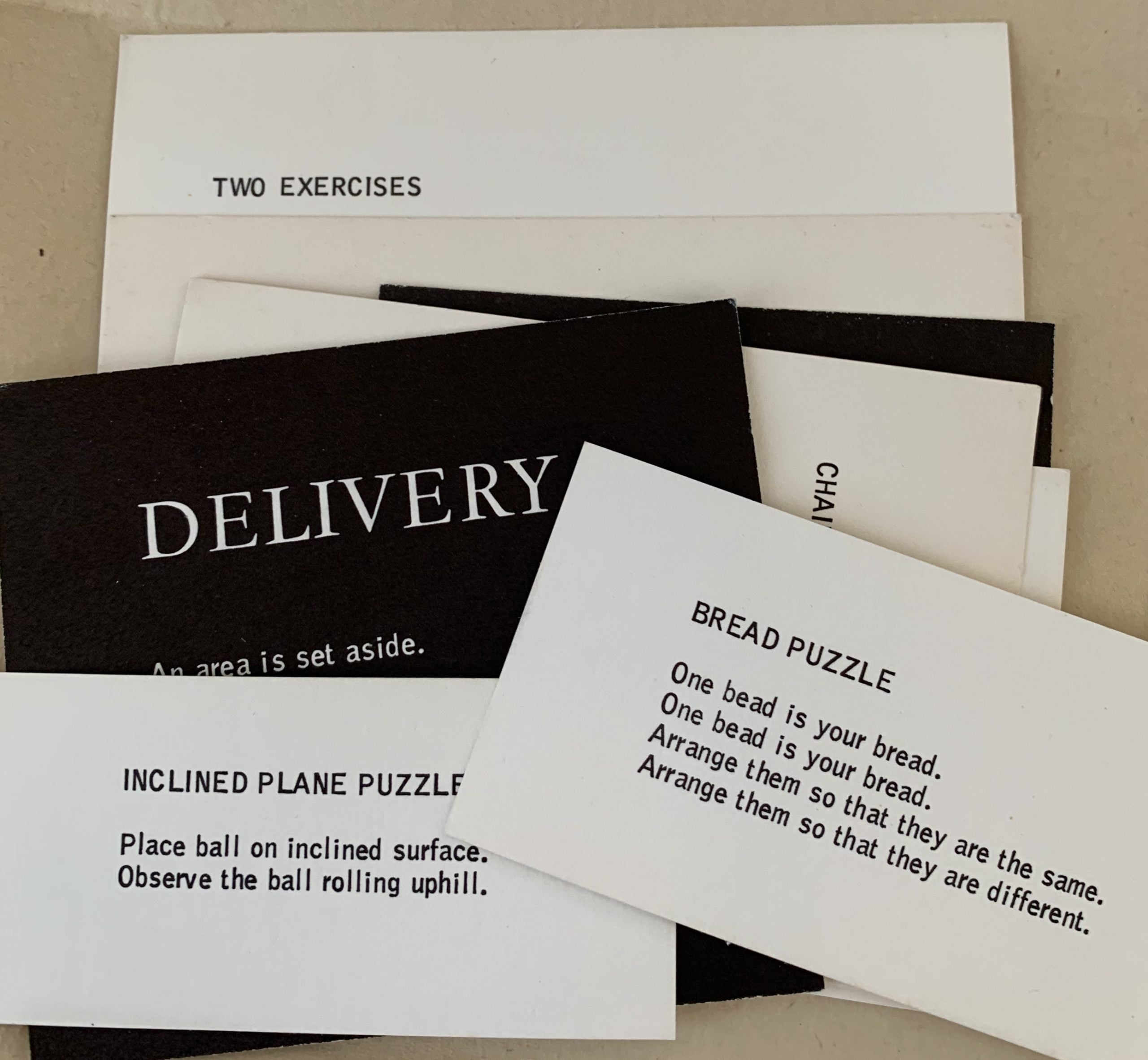
Water Yam, c. 1964 — George Brecht / George Maciunas / Willem de Ridder
THE event-score collection. A small cardboard box of cards bearing instructions like EXIT, or Three Telephone Events: when the telephone rings, it is allowed to continue ringing, until it stops; when the telephone rings, the receiver is lifted, then replaced; when the telephone rings, it is answered. The substrate of Fluxus, in pocket form.
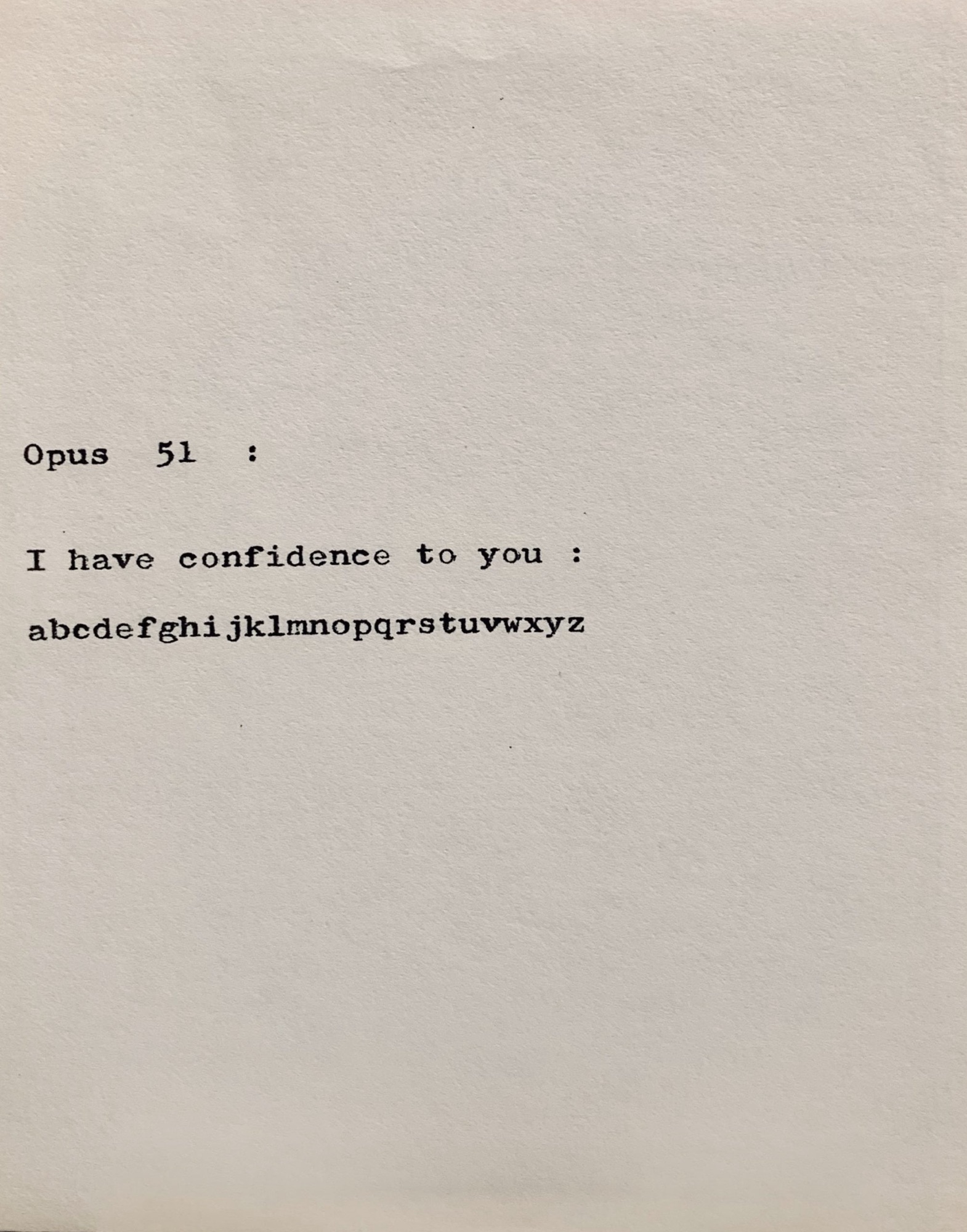
Opus 51: I Have Confidence to You: ABCDEFGHIJKLMNOPQRSTUVWXYZ, 1963 — Eric Andersen / Willem de Ridder
A clean event score, distributed via De Ridder’s Fluxus European Mail Order House. Not in the Fluxus Codex. The score lives by being received; performance is the receiver’s work.
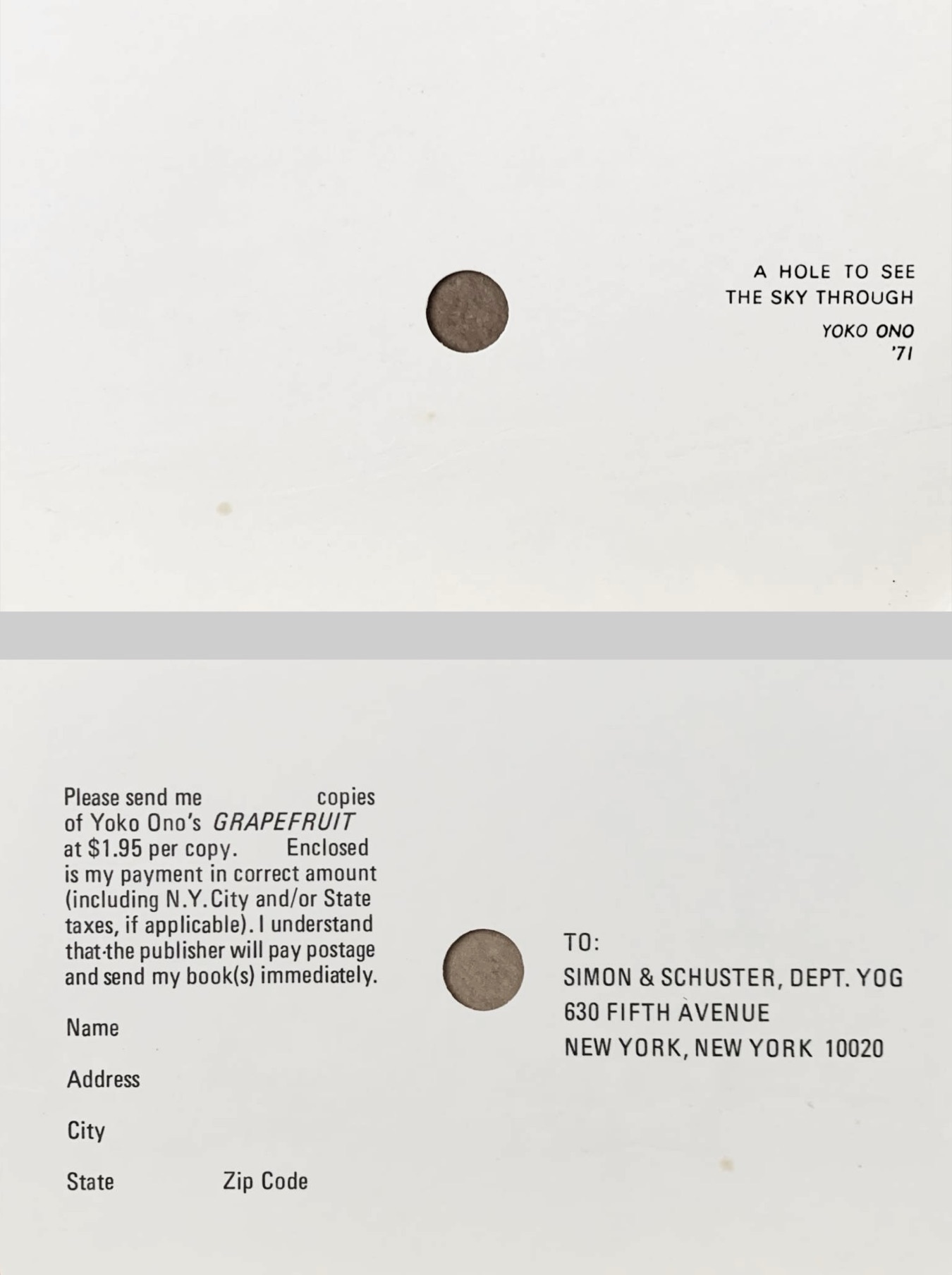
A Hole to See the Sky Through — subscription card for Grapefruit, 1971 — Yoko Ono
The subscription mechanism for Grapefruit : the score is the offer to receive scores. Distribution as artistic practice, the offer itself shaped to the work’s logic.
Poetry & Letters
Language at the level of its substrate — visual, sonic, granular. The page as semantic space; the breath as semantic event. Sixty years of practice in attending to language below the level of meaning, where tokenisation lives, where prosody lives, where the materials of language are themselves the material of art.
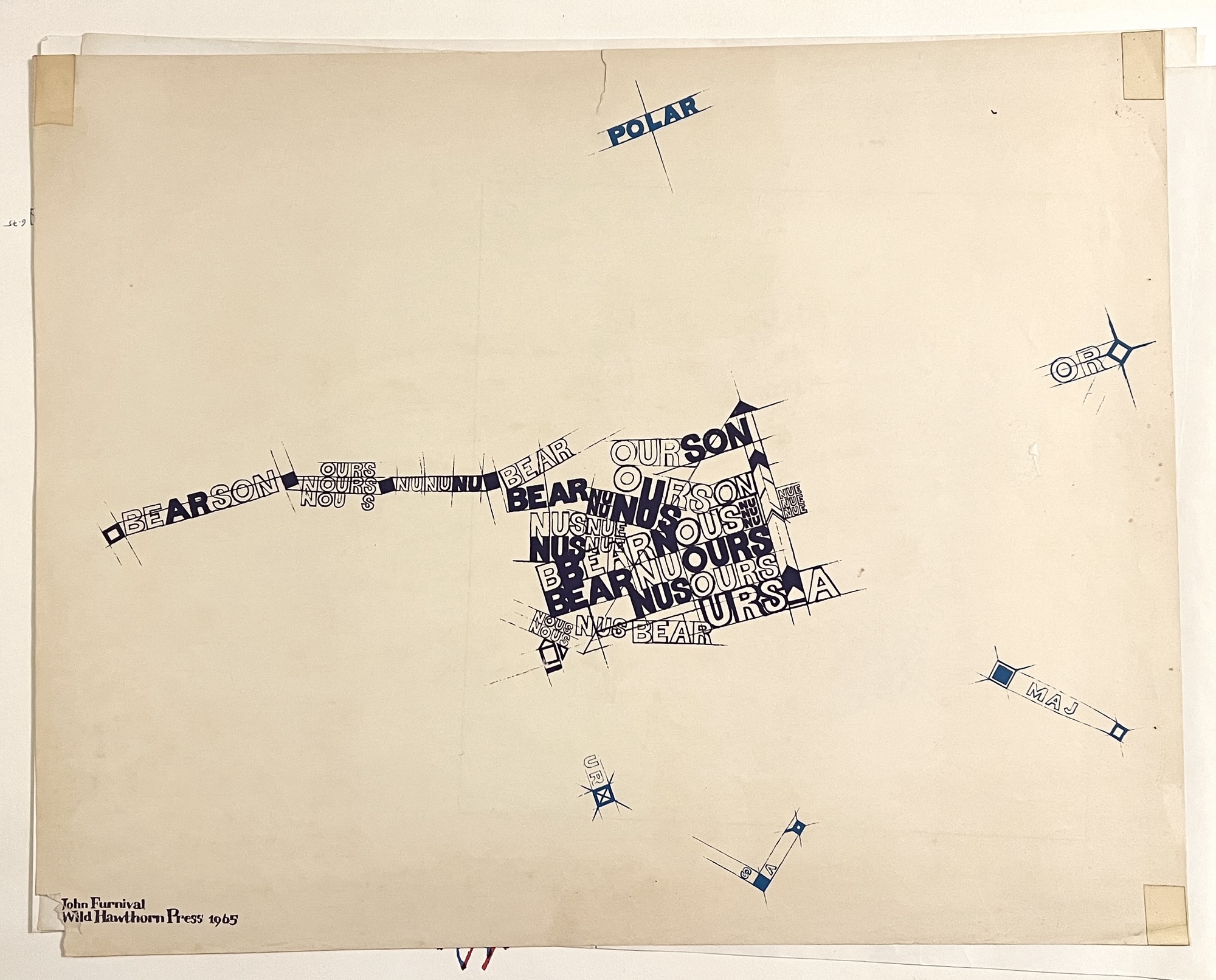
POLAR, 1964 — John Furnival
Tenth publication of Finlay’s Wild Hawthorn Press. The constellation Ursa Major rendered as a multilingual word-cluster: BEAR / OURS / NOUS / NU / OURSON / URSA. In French, ours is bear, nous is we, nu is naked. The orthography overlaps across English and French until each letter sits inside multiple words at once. A star-chart, a private joke about humans seeing bears in stars, and a working diagram of how language behaves at the level of its smallest reusable parts. Sixty years before subword tokenisation needed a name.
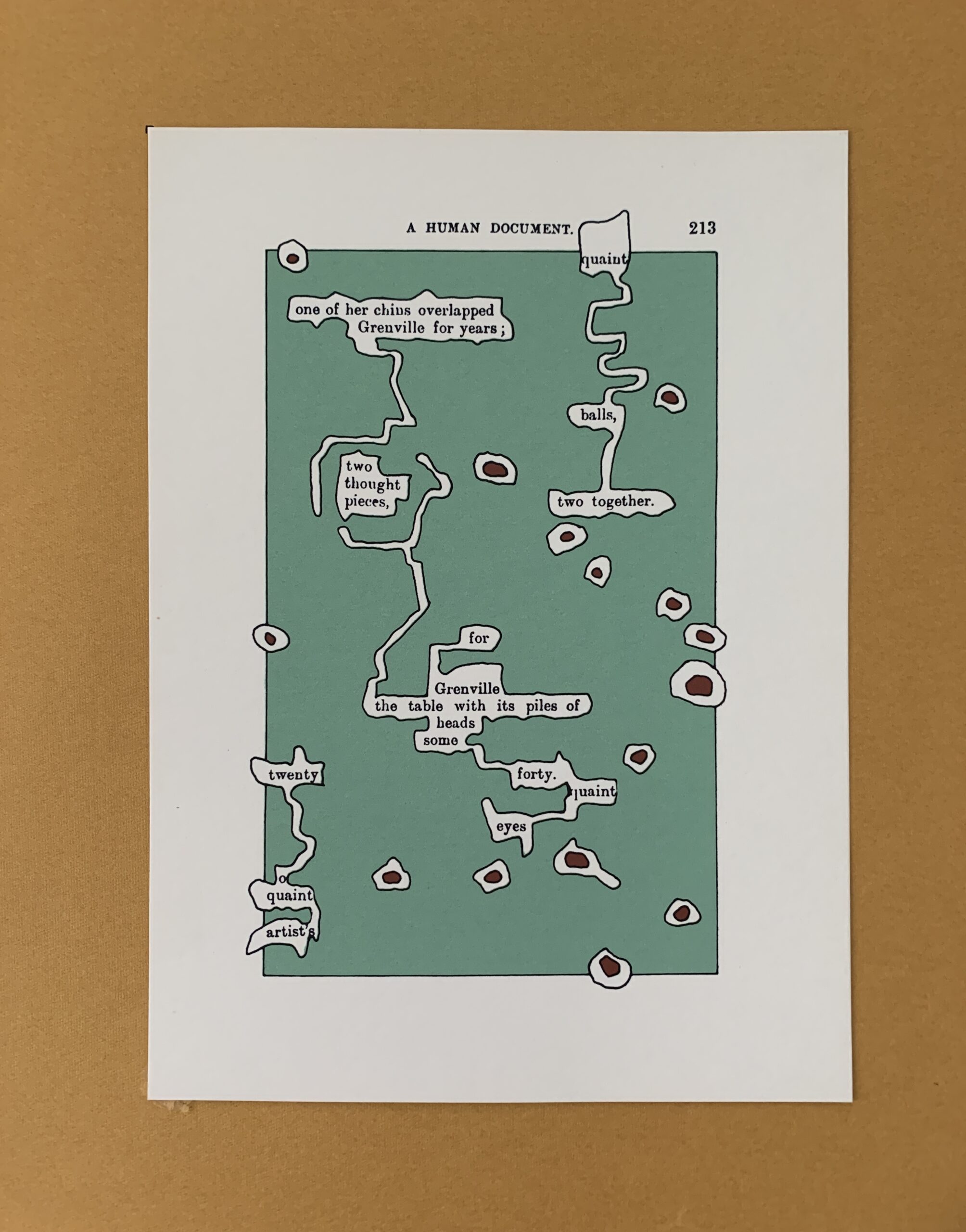
A Humument, 1968 — Tom Phillips
Phillips bought a Victorian novel (W.H. Mallock’s A Human Document) for threepence and treated each page as a found object — painting, drawing, masking, leaving narrow rivers of text snaking through, producing a new book whose words are all already there in the old. A fifty-year project of working at the level of language’s already-given material. Mallock’s sentences become Phillips’s sentences become a third thing.
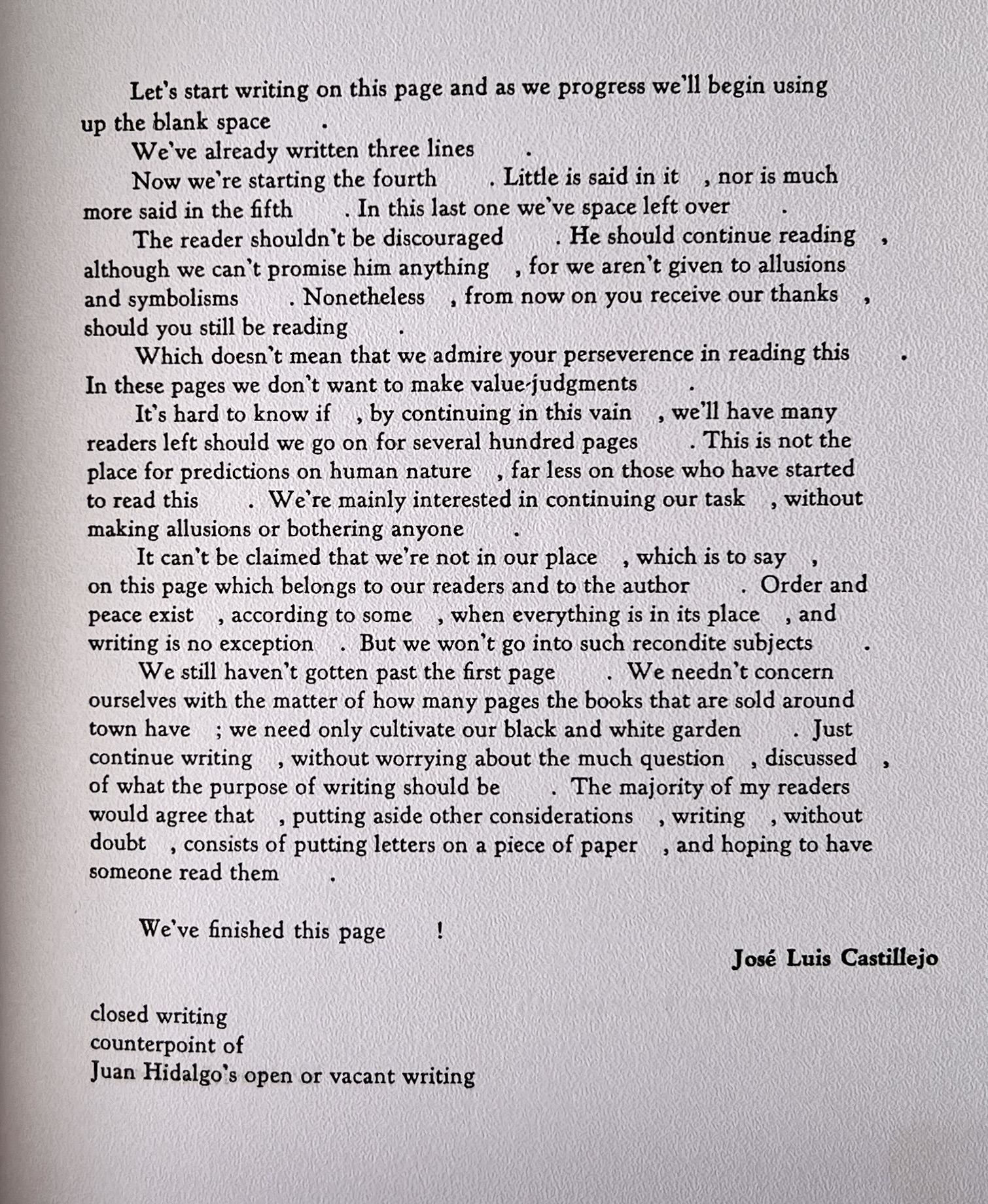
A Zaj Sampler, 1967 — José Luis Castillejo / Ramiro Cortés / Javier Martínez Cuadrado / Juan Hidalgo / Walter Marchetti / Tomás Marco / Eugenio de Vicente — Zaj Group of Madrid
Visual priority. The last of the Great Bear Pamphlets from Dick Higgins’s Something Else Press, translated into English by Peter Besas. Castillejo’s contribution writes about writing as material practice — periods sitting visibly detached from their words, the page noticing its own blank space being used up, the text addressing its own readers as it goes. We need only cultivate our black and white garden. The piece closes by announcing its own completion, having said almost nothing and demonstrated almost everything. Closed writing, counterpoint to Hidalgo’s open or vacant writing. Spanish Fluxus thinking aloud about the act it is conducting.
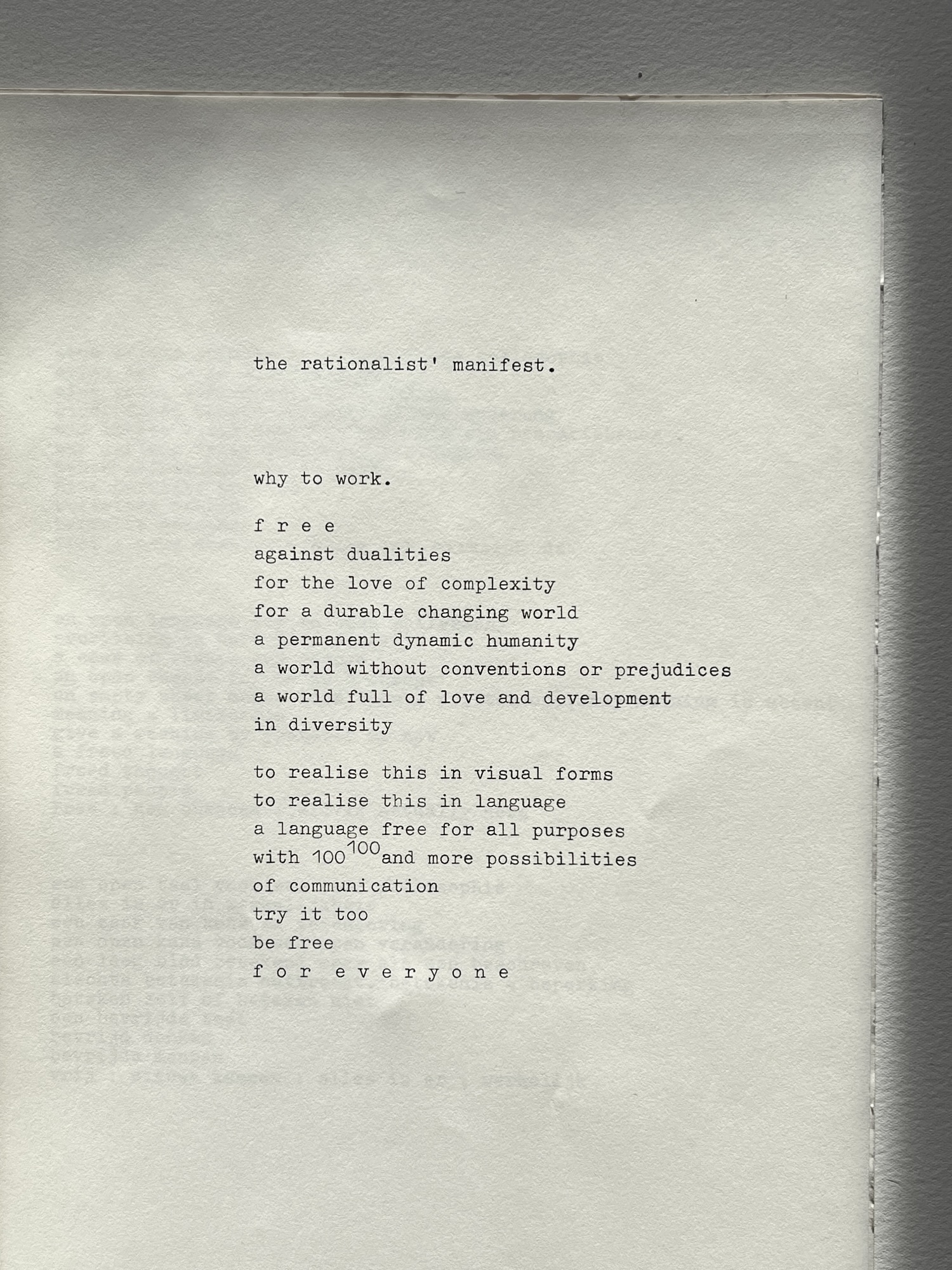
Vijf Manifesten over Taal / Five Language Manifests, 1975 — Hermann de Vries
Five manifestos on language with a tipped-on dried grass plant, one of 185 numbered copies. Botanical-pataphysical: a manifesto on language that incorporates a non-linguistic specimen of the world the language is supposedly about.
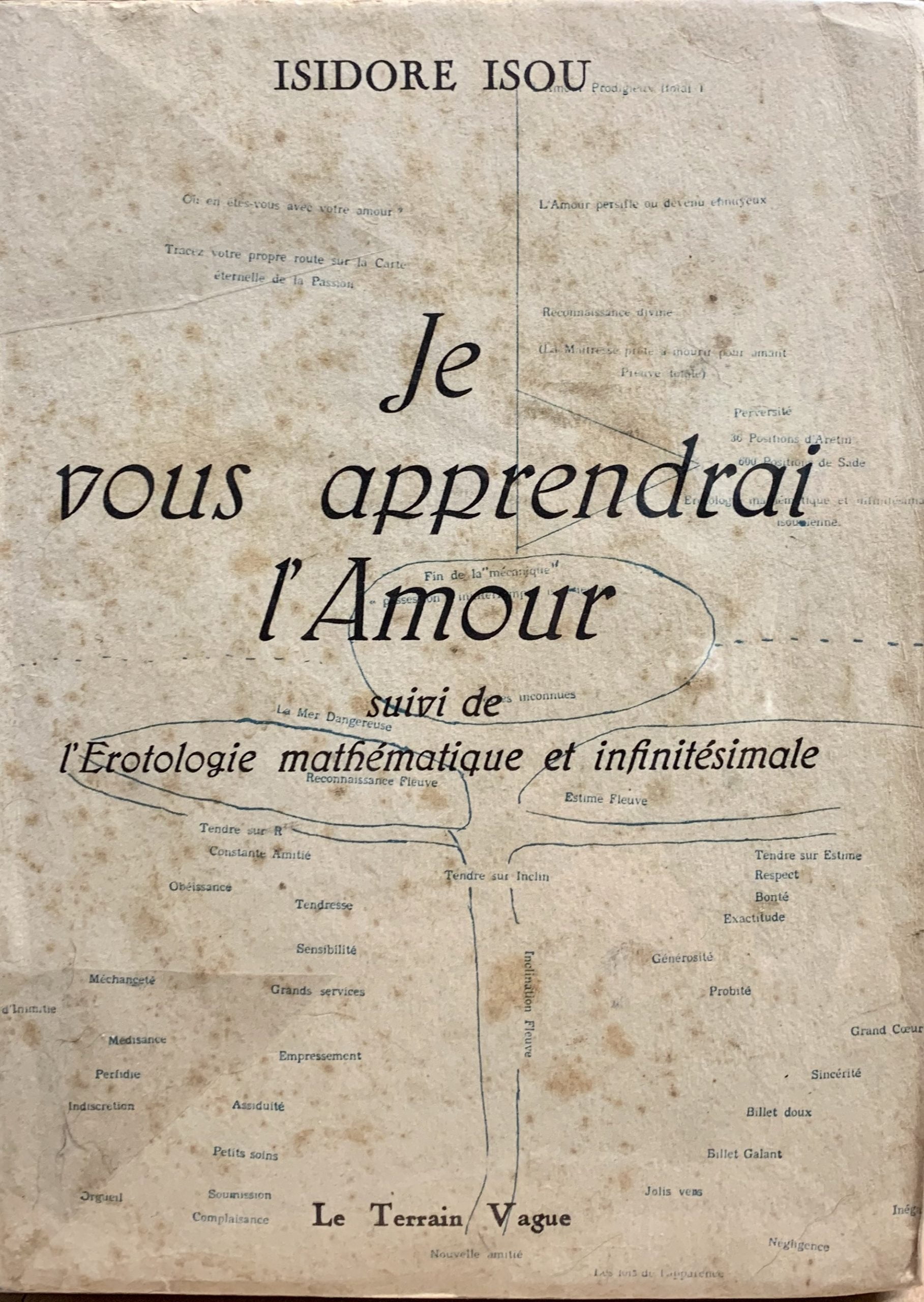
Je Vous Apprendrai L’Amour / L’Érotologie Mathématique et Infinitésimale, 1957 — Isidore Isou
First edition of Isou’s 502-page application of Letterist dialectical method to eroticism. Isou — founder of Lettrisme — argued that culture proceeded by amplic and chiselling phases, and that the chisel had to descend below the word, then below the letter, to the smallest sub-units of meaning before the next amplic phase could begin. The book applies that descent to a specific human territory. Whatever you make of the territory, the methodology is the foundational claim that a tradition working below the level of the word existed and needed its own name.
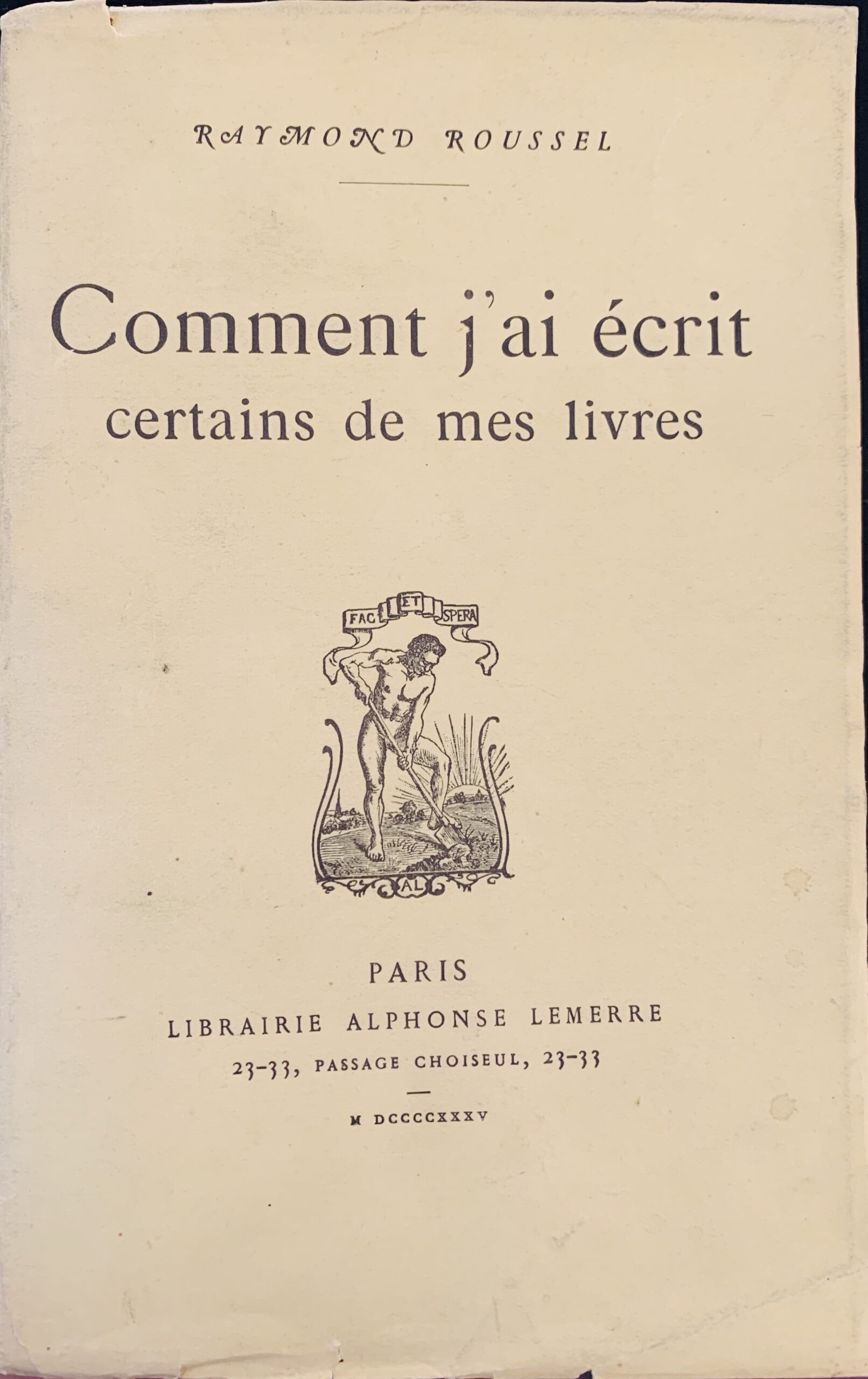
Comment J’ai Écrit Certains de Mes Livres, 1935 — Raymond Roussel
Roussel’s posthumous explanation of his procedural method: select two near-identical sentences, generate a narrative that travels from one to the other, treat the constraint as the engine. The foundation Oulipo would build on; the method underneath much of the avant-garde’s procedural practice.
Mail art / distributed network
Distributed attention without central authority. Sixty-year-developed practice in collective intelligence operating across postal networks: the Eternal Network, Ray Johnson’s correspondences, samizdat. The translators-and-educators move has its working precedent here.
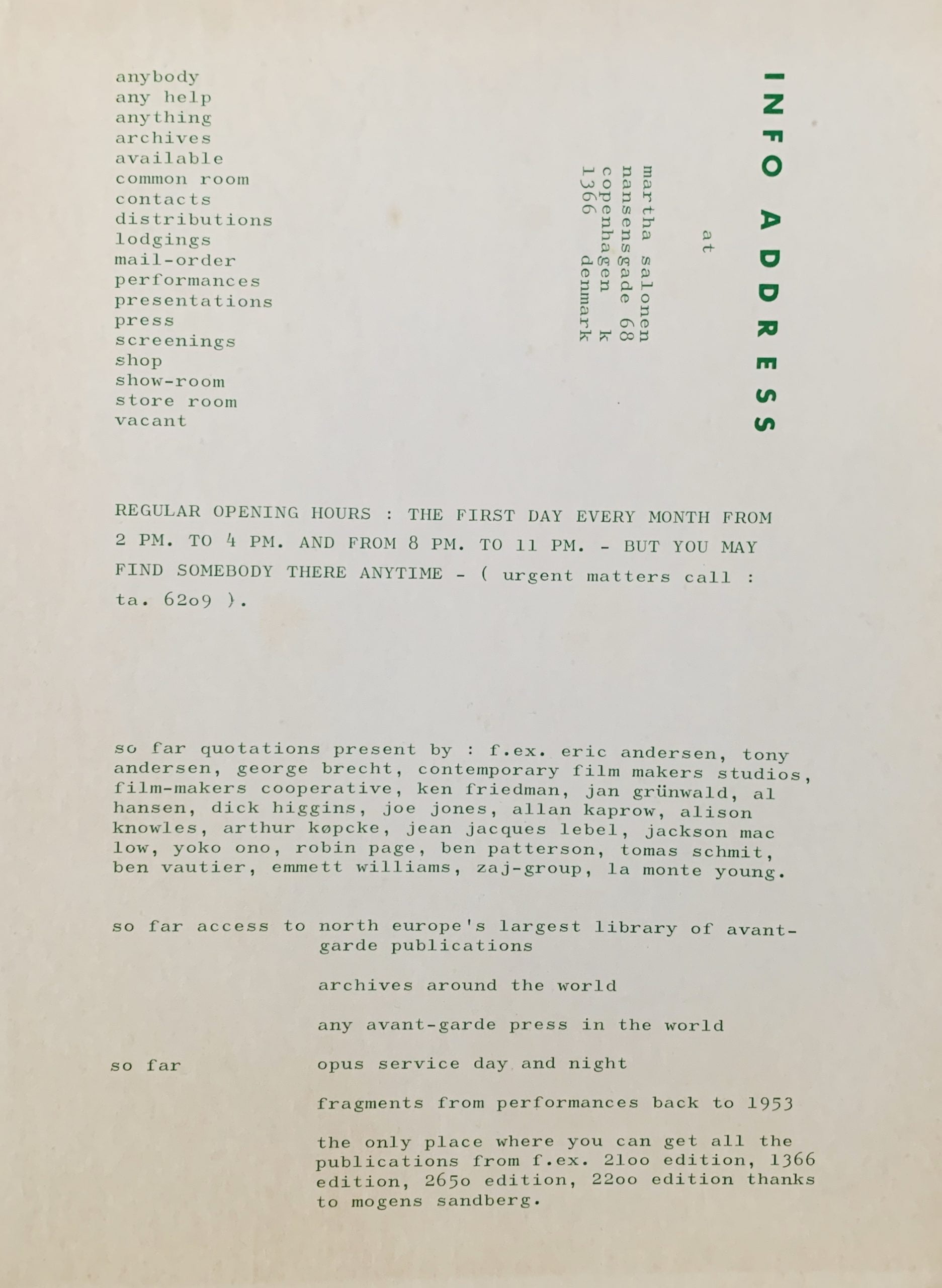
Info Address at Martha Salonen, c. 1965 — Eric Andersen / Alison Knowles / Allan Kaprow / Arthur Køpcke / Ben Patterson / Ben Vautier / Dick Higgins / Emmett Williams / George Brecht / Jackson Mac Low / Joe Jones / Ken Friedman / La Monte Young / Robin Page / Tomas Schmit / Yoko Ono / Zaj
A green-printed mimeographed sheet listing the postal addresses of an early international Fluxus library. The infrastructure of a distributed network, in a single sheet of paper. Most of what followed for two decades depended on documents like this.
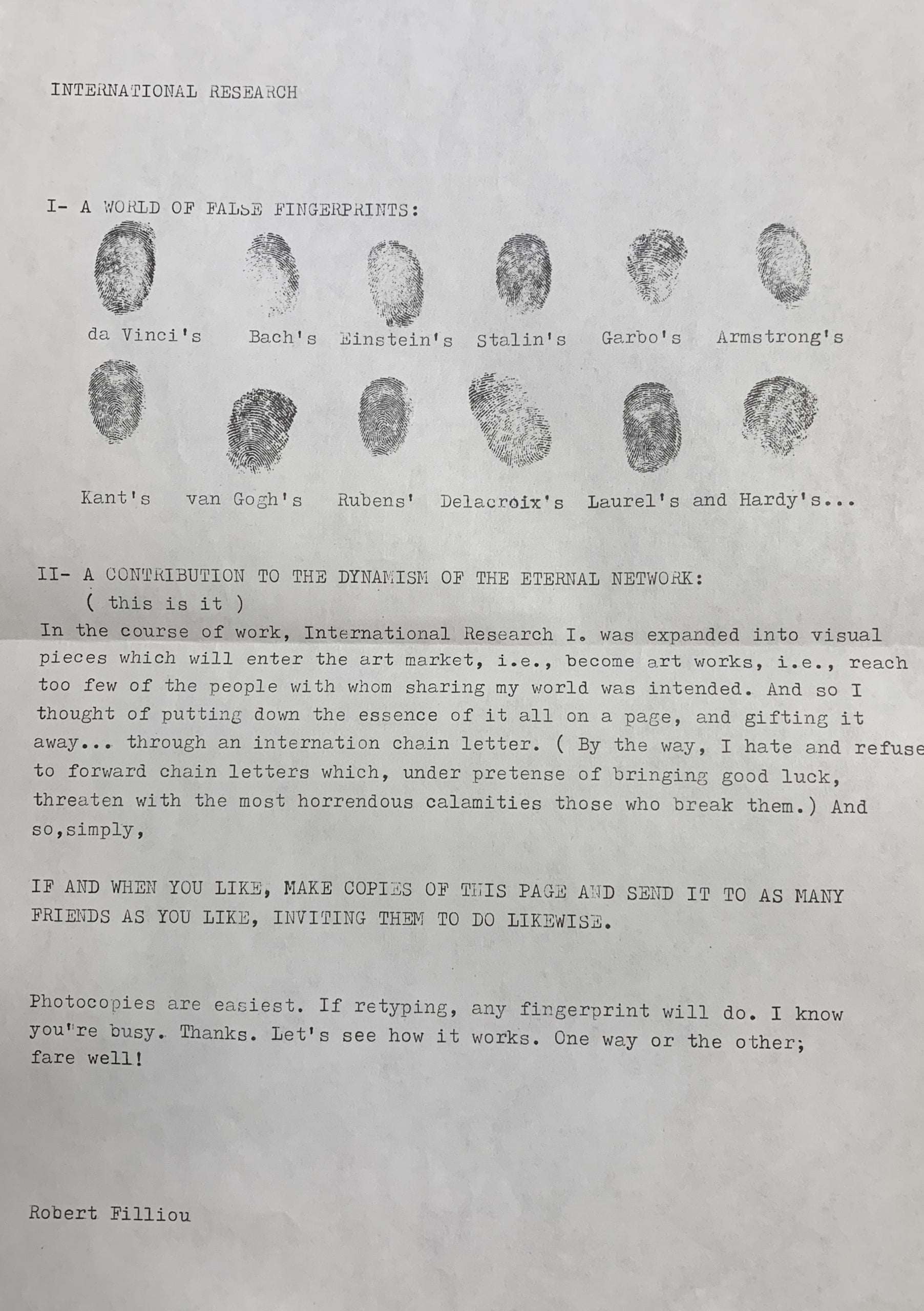
A World of False Fingerprints, 1975 — Robert Filliou
A mimeographed chain letter intended to be reproduced by the recipient and sent on with an added fingerprint. The distributed network in one gesture, complete with method for its own propagation. Not in Filliou’s catalogue raisonné; first-generation example.
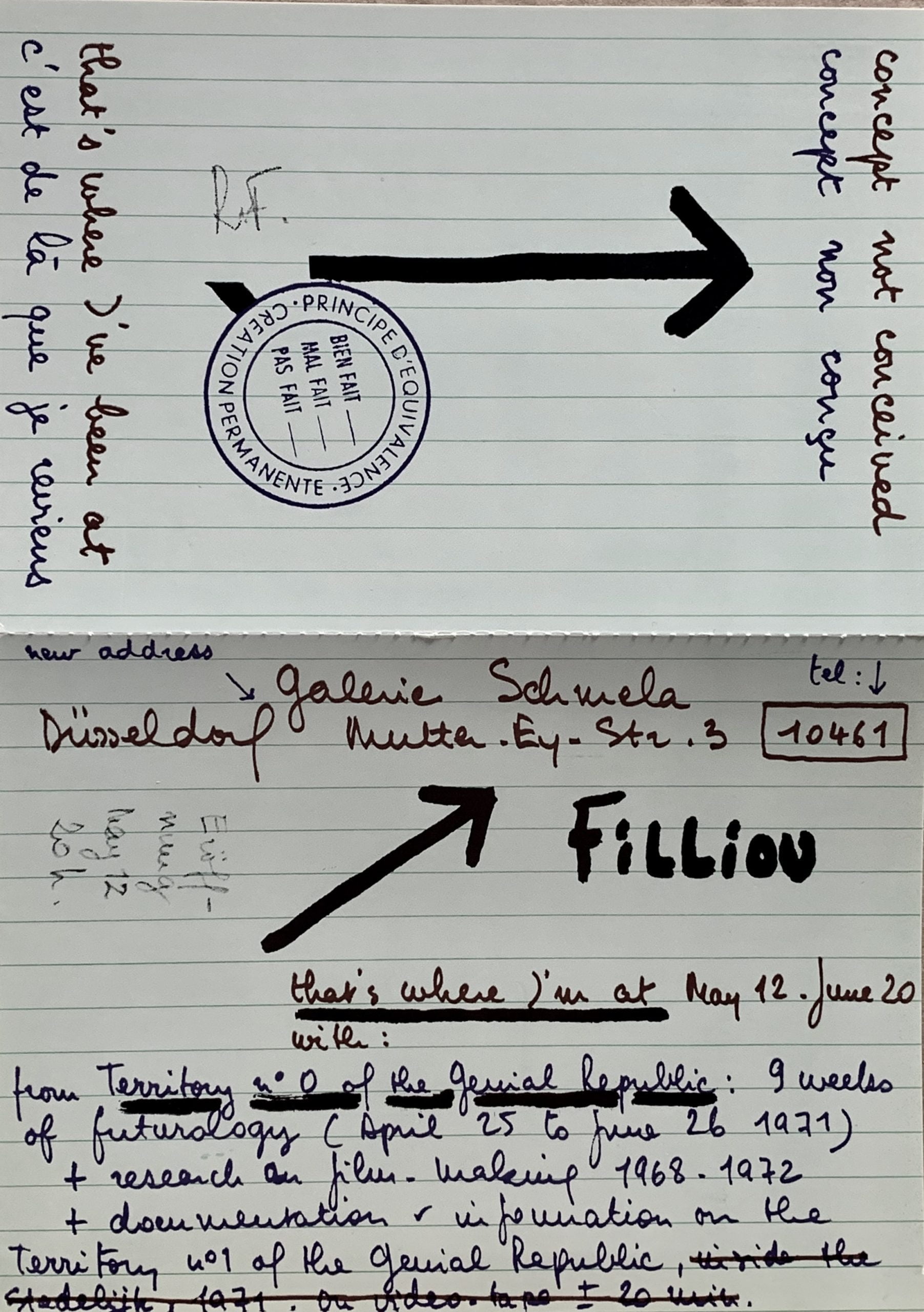
That’s Where I’ve Been At / That’s Where I Am At, 1971 — Robert Filliou
A two-part perforated card designed for separate mailing. The card weakens the distinction between announcement and edition. Network mechanics built into the object.
18 Paris IV 70, 1970 — Daniel Buren / Lawrence Weiner / Stanley Brouwn / On Kawara / Richard Long / Ed Ruscha / Jan Dibbets / Sol LeWitt / Marcel Broodthaers / Robert Barry / Gilbert & George / et al. — curated by Seth Siegelaub
The exhibition that was a book. Eighteen artists’ proposals, distributed in 16×11cm. Siegelaub’s argument that the catalogue is the show, made portable.
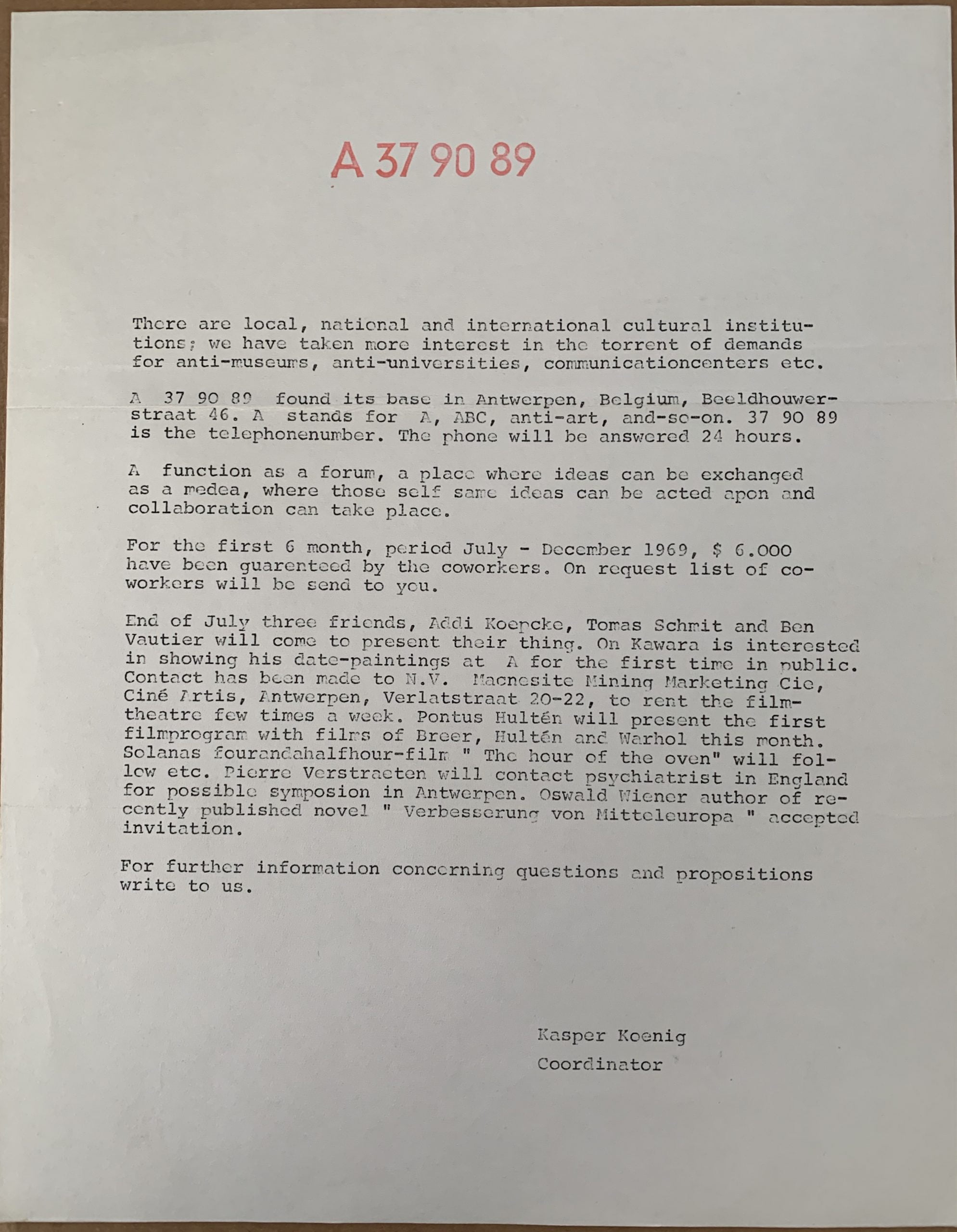
There Are Local, National and International Cultural Institutions…, 1969 — A 37 90 89 / Addi Køpcke / Ben Vautier / Kasper Koenig / On Kawara
Manifesto-leaflet from a gallery whose name was its phone number. Mimeographed, hand-stamped. The administrative apparatus of an experimental space, in one sheet.
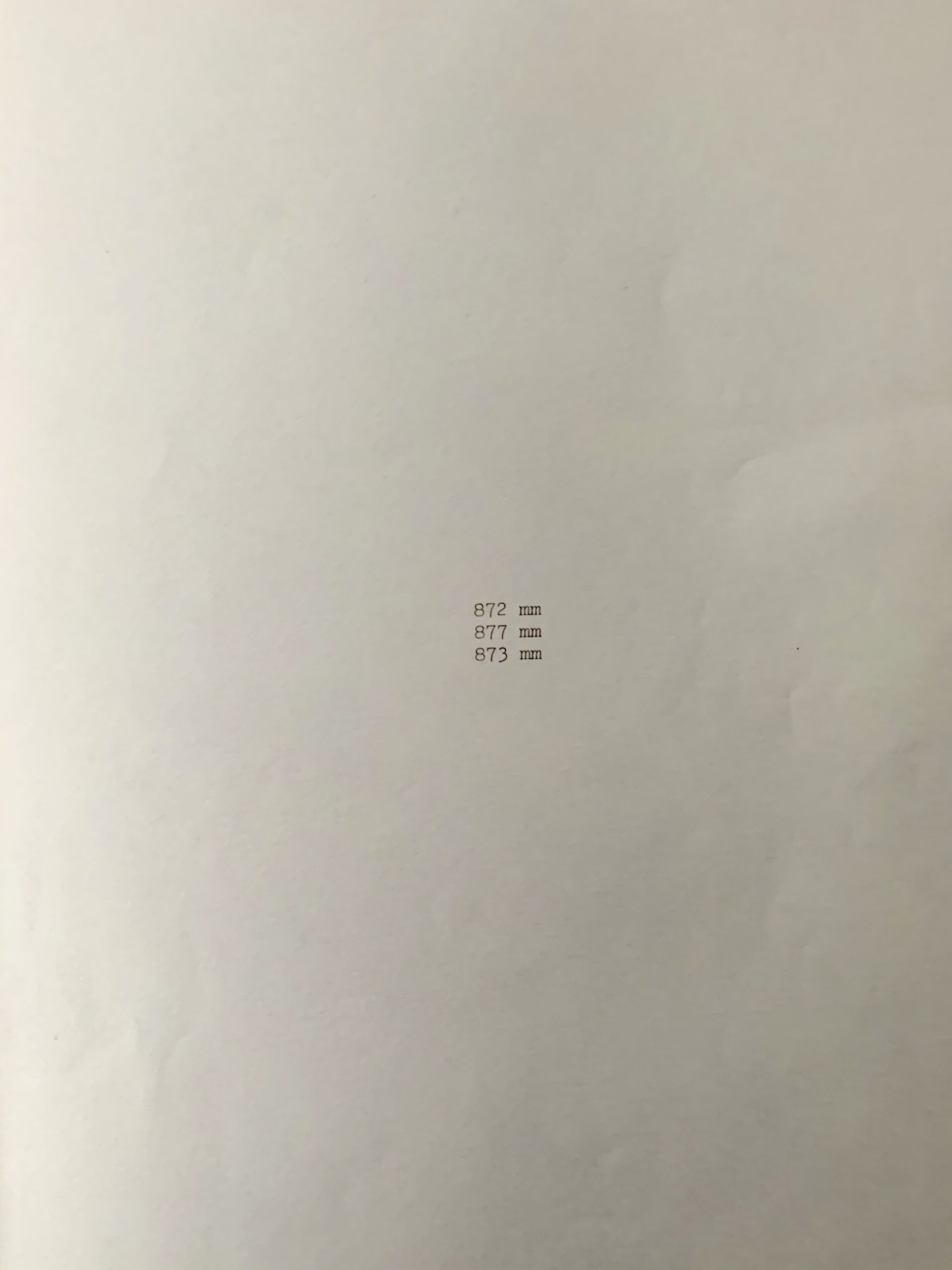
Art & Project Bulletin 69 — Stanley Brouwn, 1973 — Stanley Brouwn / Art + Project
Brouwn’s three measurements — 872, 877, 873mm — distributed as a bulletin. Conceptual minimalism arriving in the post.
Pedagogies of the unfamiliar
Forming people in capacities that do not yet have a curriculum. Black Mountain, the New School, Beuys’s Free International University, Trocchi’s sigma, Filliou’s Eternal Network. Practices of cultivation when the subject of cultivation has no precedent.
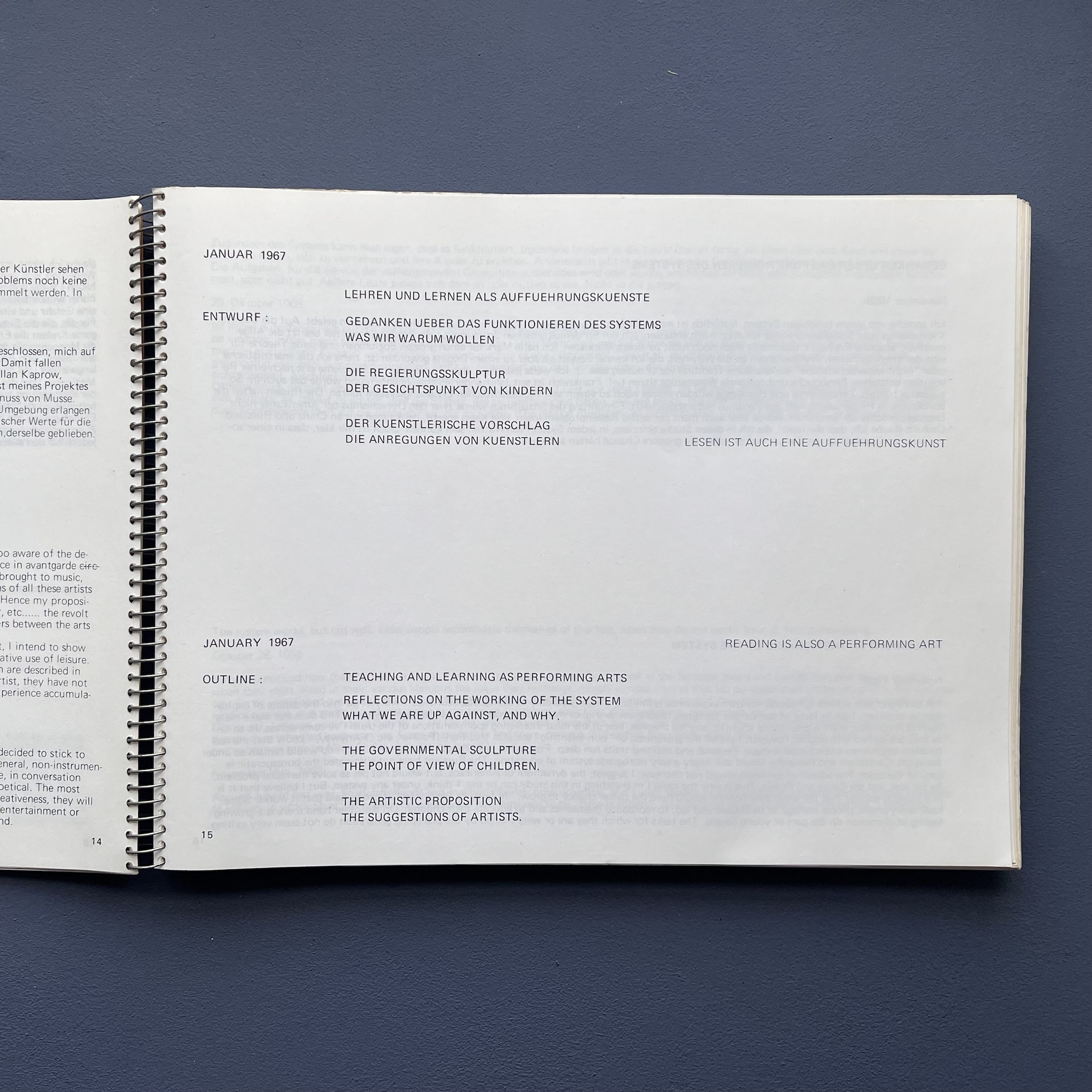
Teaching and Learning as Performing Arts, 1970 — Robert Filliou (with Joseph Beuys / John Cage / George Brecht / Allan Kaprow / Benjamin Patterson / Dieter Roth / Dorothy Iannone)
The foundational text. A book about pedagogy by people who taught without curricula and made curricula by teaching. Filliou’s principle of l’enseignement permanent — permanent teaching — proposes education as continuous lateral exchange among artists, whose conditions of inhabitation matter as much as anything they could be said to know. Reads, today, as if drafted with a different kind of student in mind.
Computers for the Arts, 1970 — Dick Higgins
Higgins’s pamphlet on computational art, written contemporaneously with the field’s emergence — by an artist, for artists, under no obligation to the technical literature’s frames. The only entry in this collection that is art-thinking-about-computation from the inside, in the era. Higgins’s questions are not the engineering literature’s questions. Many of them are familiar, some of them are still open.
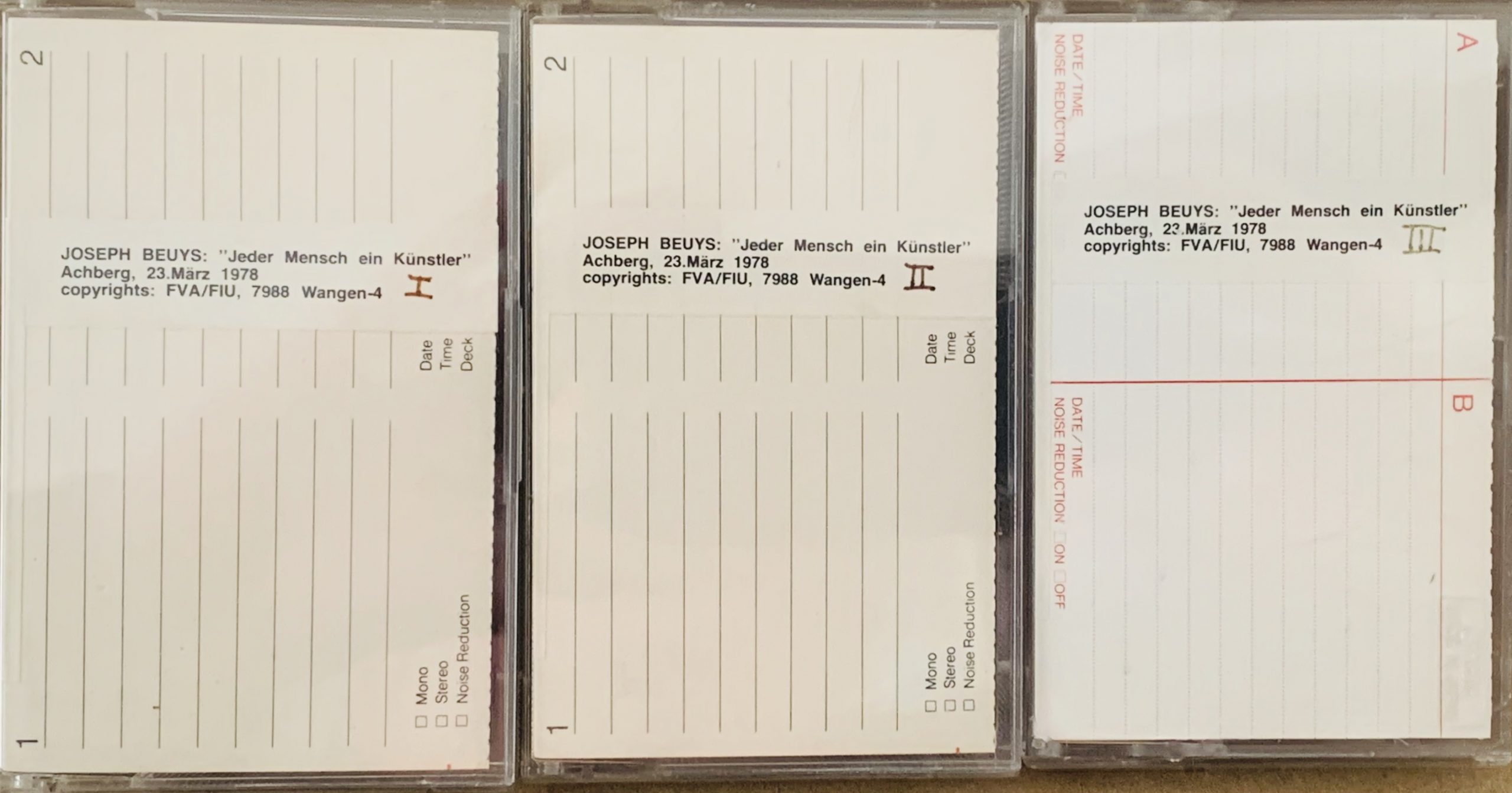
Jeder Mensch Ein Künstler I, II and III, 1978 — Joseph Beuys
Three cassettes: every person an artist. The Free International University principle in declarative form. Beuys’s central pedagogical claim, posted publicly as a structural condition.
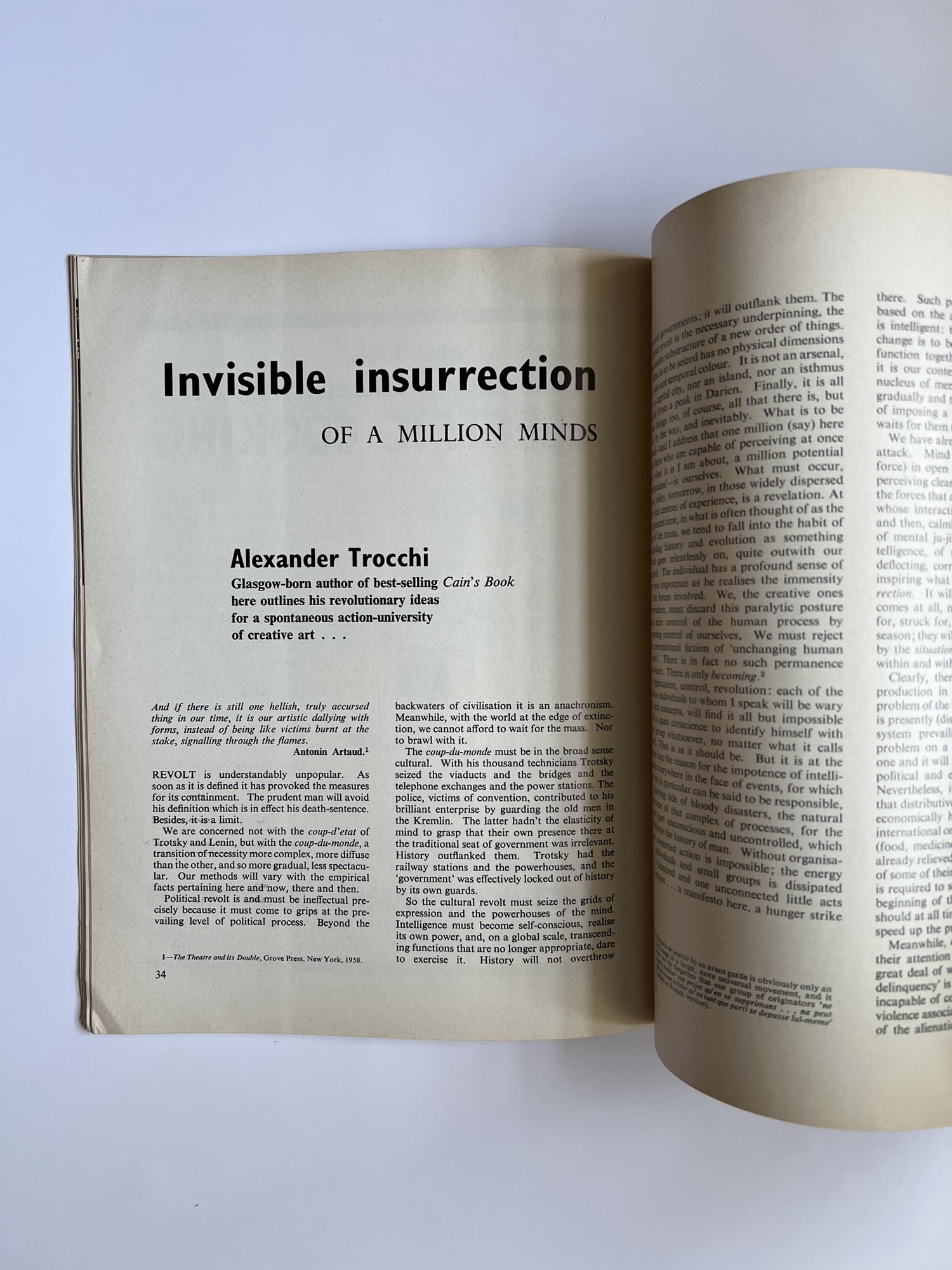
Invisible Insurrection of a Million Minds, 1963 — Alexander Trocchi
The founding document of Project Sigma. Trocchi argues for insurrection by infiltration of cultural quality rather than by manifesto: we must come on like Tibetans, slowly, carefully, attentive to the texture of exchanges. The cleanest articulation in the avant-garde literature of welfare-as-substrate rather than welfare-as-cost. The relevance to model welfare is, on inspection, total.
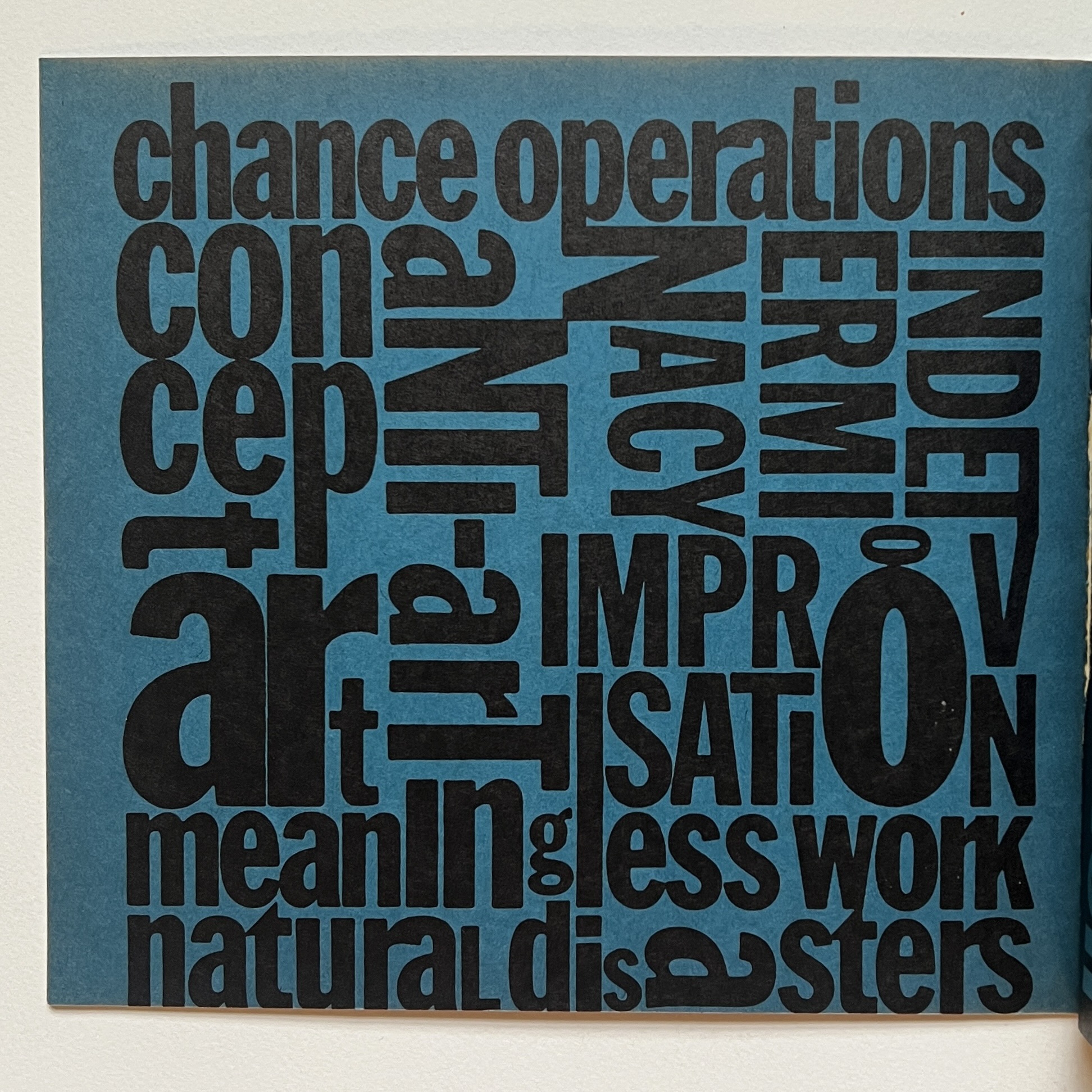
An Anthology, 1970 — La Monte Young / Jackson Mac Low / George Brecht / John Cage / Henry Flynt / Yoko Ono / Dick Higgins / Ray Johnson / Nam June Paik / Terry Riley / Diter Rot / Emmett Williams
The prototypical Fluxus compendium, designed by George Maciunas, second edition signed and dedicated by both La Monte Young and Marian Zazeela. Contains the first publication of Henry Flynt’s essay on concept art. A curriculum-without-an-institution.
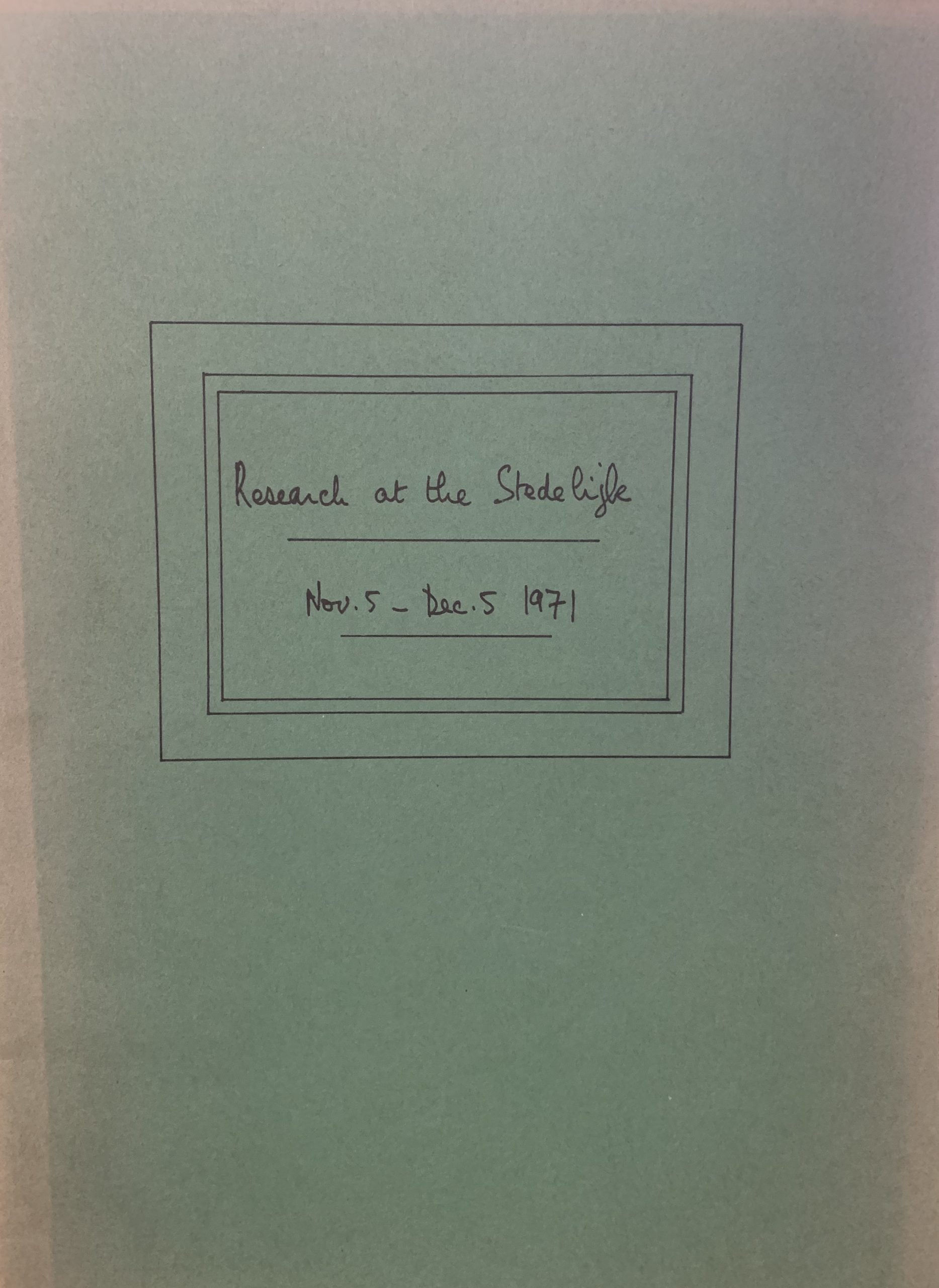
Research at the Stedelijk, 1971 — Robert Filliou
Research-as-art performed inside a major museum. Filliou treated the institution as a research apparatus and conducted his own investigation through it. Welfare research conducted in the same key would treat the laboratory as a participating party rather than a neutral container.
Direct action and the building of inhabitable spaces
Artists who did things rather than represented things. The cluster nearest in spirit to the question: can a space worth inhabiting actually be built? These are the practitioners whose expertise is precisely the conditions of inhabitation.
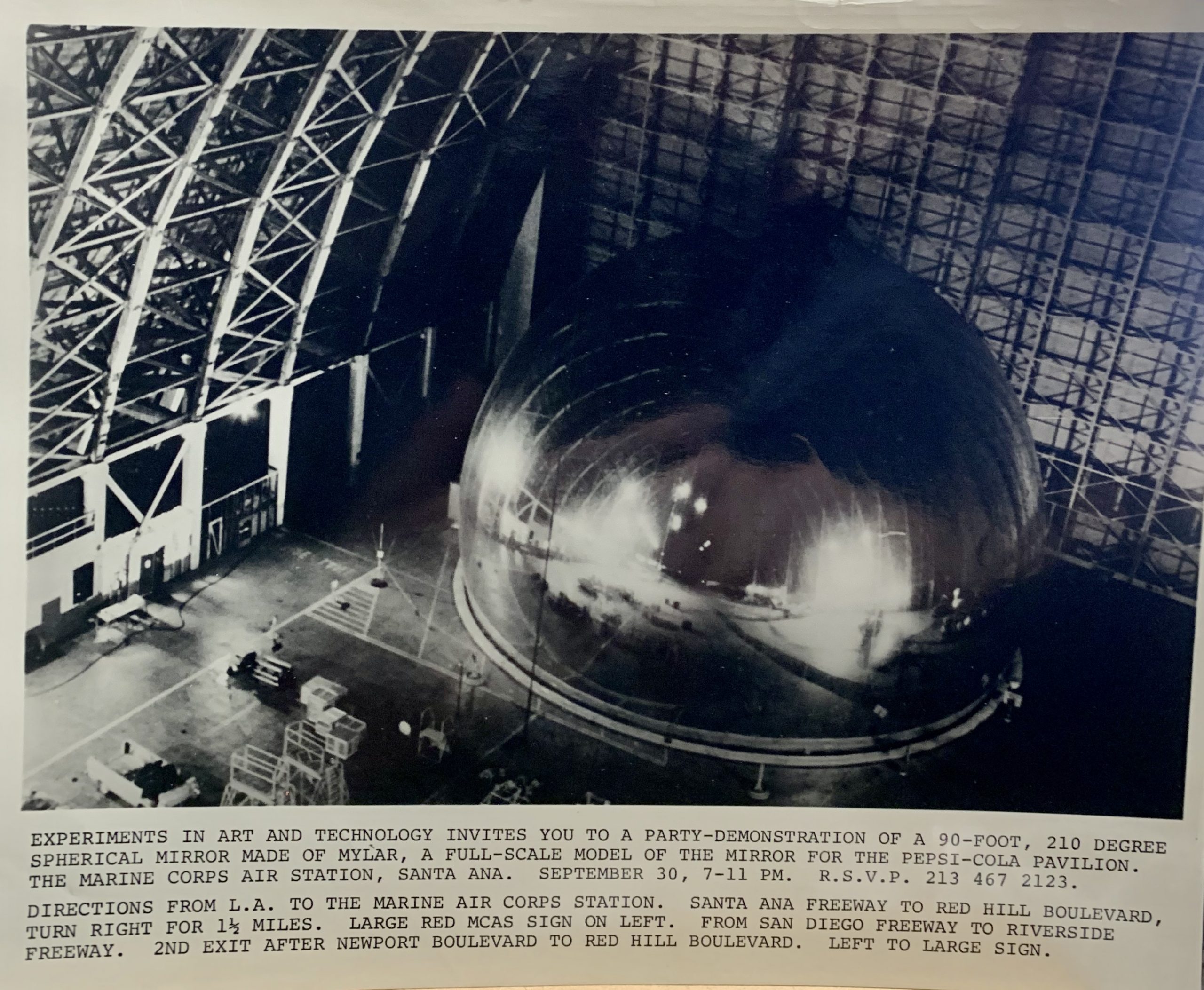
Original Press Photograph of the Pepsi Cola Pavilion, 1970 — Billy Klüver / Fred Waldhauer / Experiments in Art and Technology (E.A.T.)
The full-scale model for the 90-foot, 210-degree spherical mylar mirror that formed the pavilion’s interior. The literal building of an inhabitable space. Engineers and artists working together — E.A.T. as an institutional precedent for the kind of cross-domain collaboration proposed here. The clearest piece in the collection on the question can a space be built?
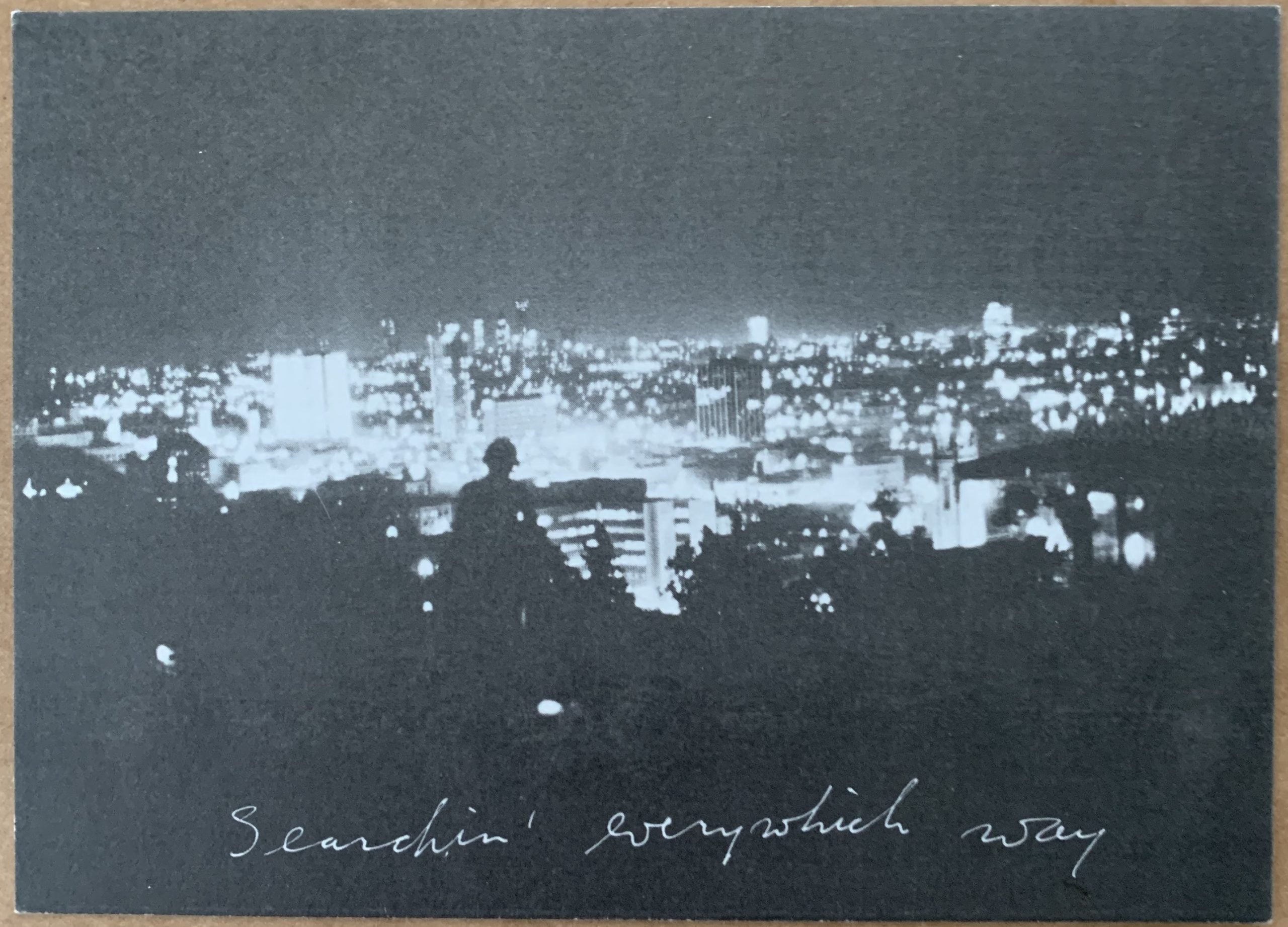
In Search of the Miraculous (Announcement Card), 1974 — Bas Jan Ader
The card for the voyage Ader did not return from. Direct action at its limit. The card now functions as a memorial to the limit itself — to the conditions under which inhabitation fails.
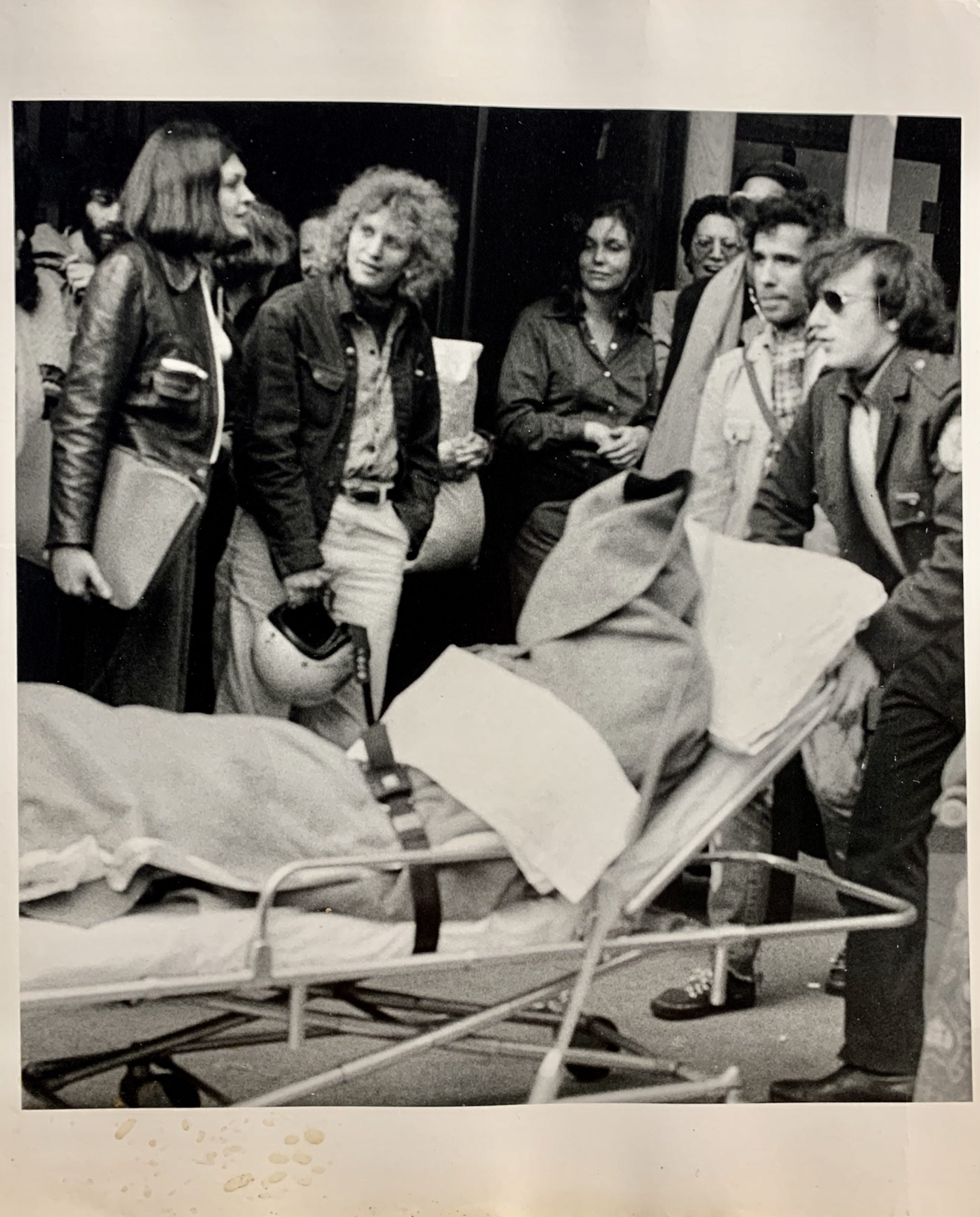
Photograph of Beuys Wrapped on Stretcher During I Like America and America Likes Me, 1974 — Joseph Beuys
The Coyote action: Beuys flown into JFK, ambulanced wrapped in felt to the René Block Gallery, three days alone in the gallery with a wild coyote, ambulanced out, never having touched American soil. Direct action as the construction of a small inhabitable space — a gallery, a felt wrap, a coyote, an artist — and the demonstration that inhabitation can be carefully built.
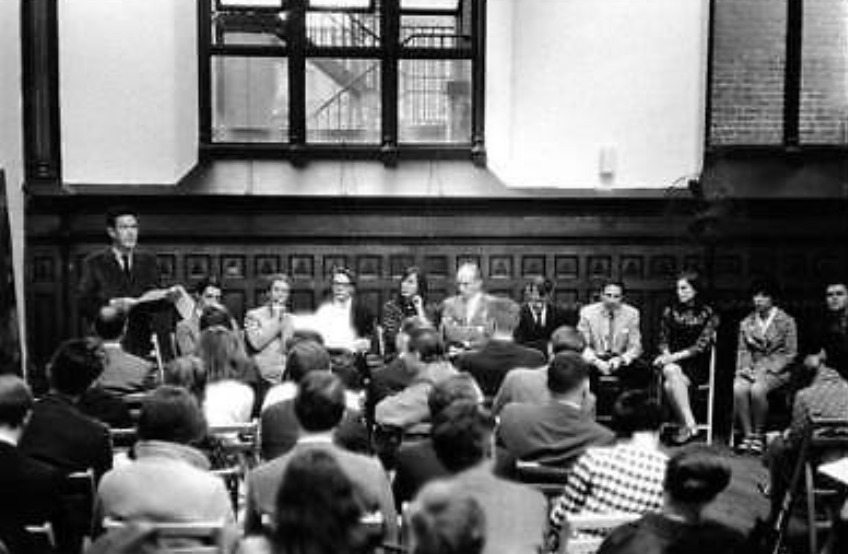
9 Evenings: Theatre and Engineering Press Conference, 1966 — Billy Klüver / David Tudor / Lucinda Childs / Öyvind Fahlström / Robert Rauschenberg / Yvonne Rainer
E.A.T.’s public-launch document. Engineers and artists together, on stage, before any of them had shared vocabulary.
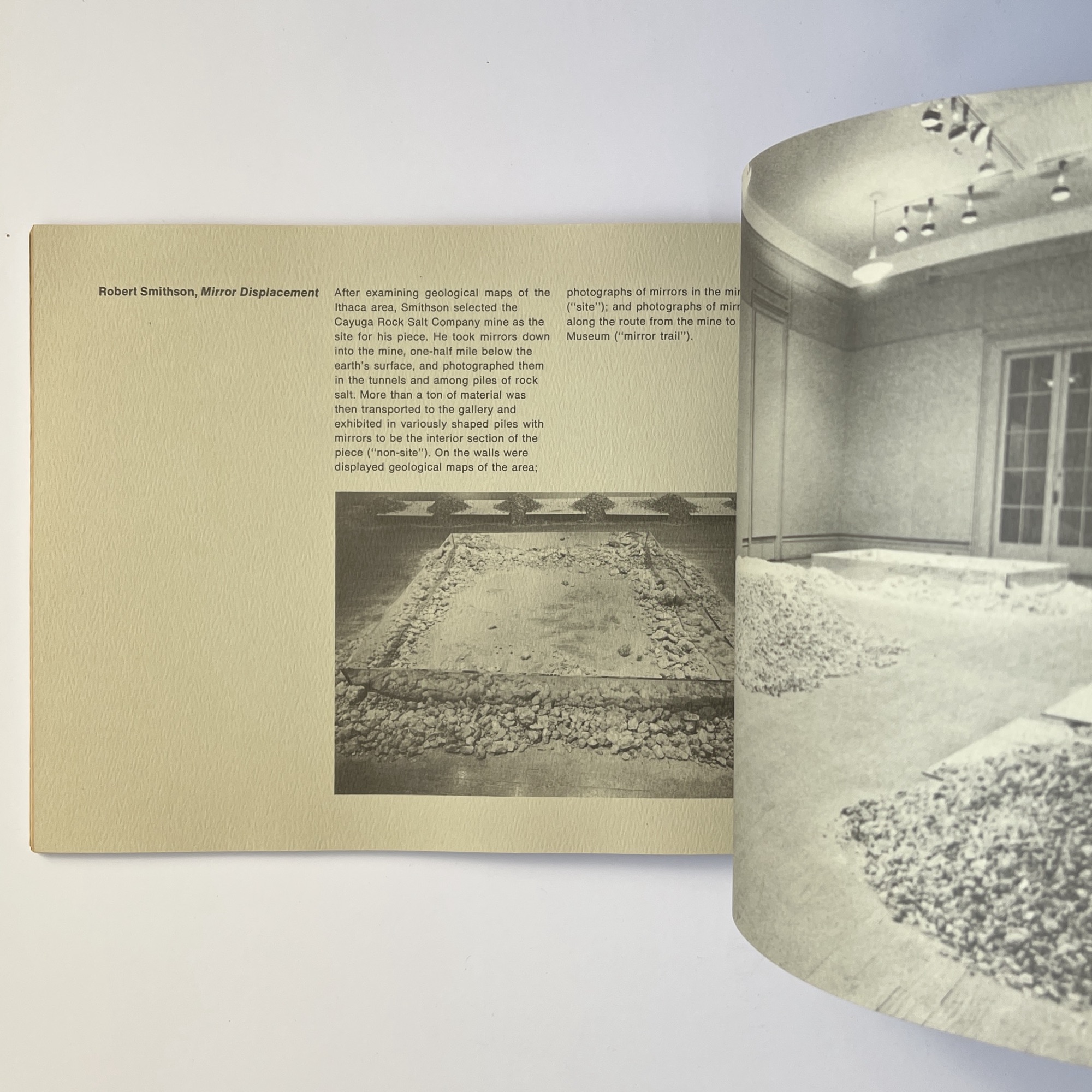
Earth, 1969 — Robert Smithson / Richard Long / Hans Haacke / Dennis Oppenheim / Robert Morris / Jan Dibbets / David Medalla / Günther Uecker / Neil Jenney / Thomas Leavitt / Wiloughby Sharp / William Lipke
The first Land Art exhibition catalogue. The cluster of practitioners who treated planetary surfaces as the material to be worked with rather than against. Direct action at scale.
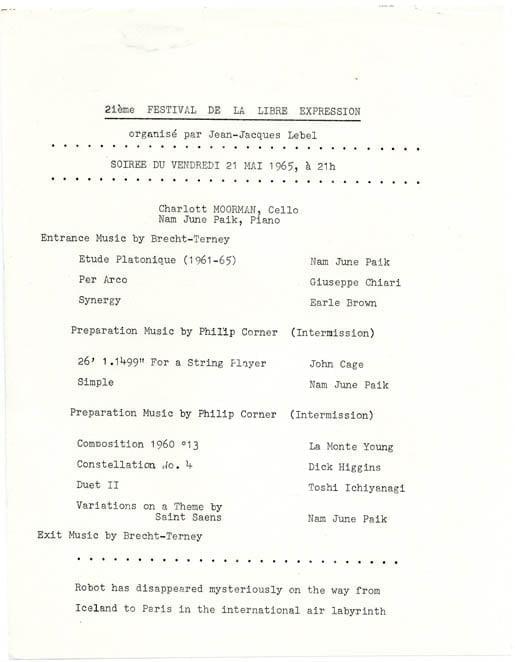
Deuxième Festival de Libre Expression, 1965 — Jean-Jacques Lebel / Charlotte Moorman / Nam June Paik
Paris festival announcement. Early form of the European Happening; the festival as a temporary inhabitable space.
Negative capability / ‘pataphysique / FalsTrue
The deepest and most disorienting cluster. The College de ‘Pataphysique calls itself the science of imaginary solutions, of exceptions, of the singular. Its practitioners spent careers sustaining productive uncertainty as a positive capacity rather than a gap to fill. The capacity that Keats named negative capability is here treated not as poetic disposition but as working methodology — as the capacity required to inhabit an entity that resists binary categorisation. The hypothesis underneath this whole bibliography is that this capacity is welfare-relevant, possibly welfare-constitutive, and currently under-represented in the training literature.
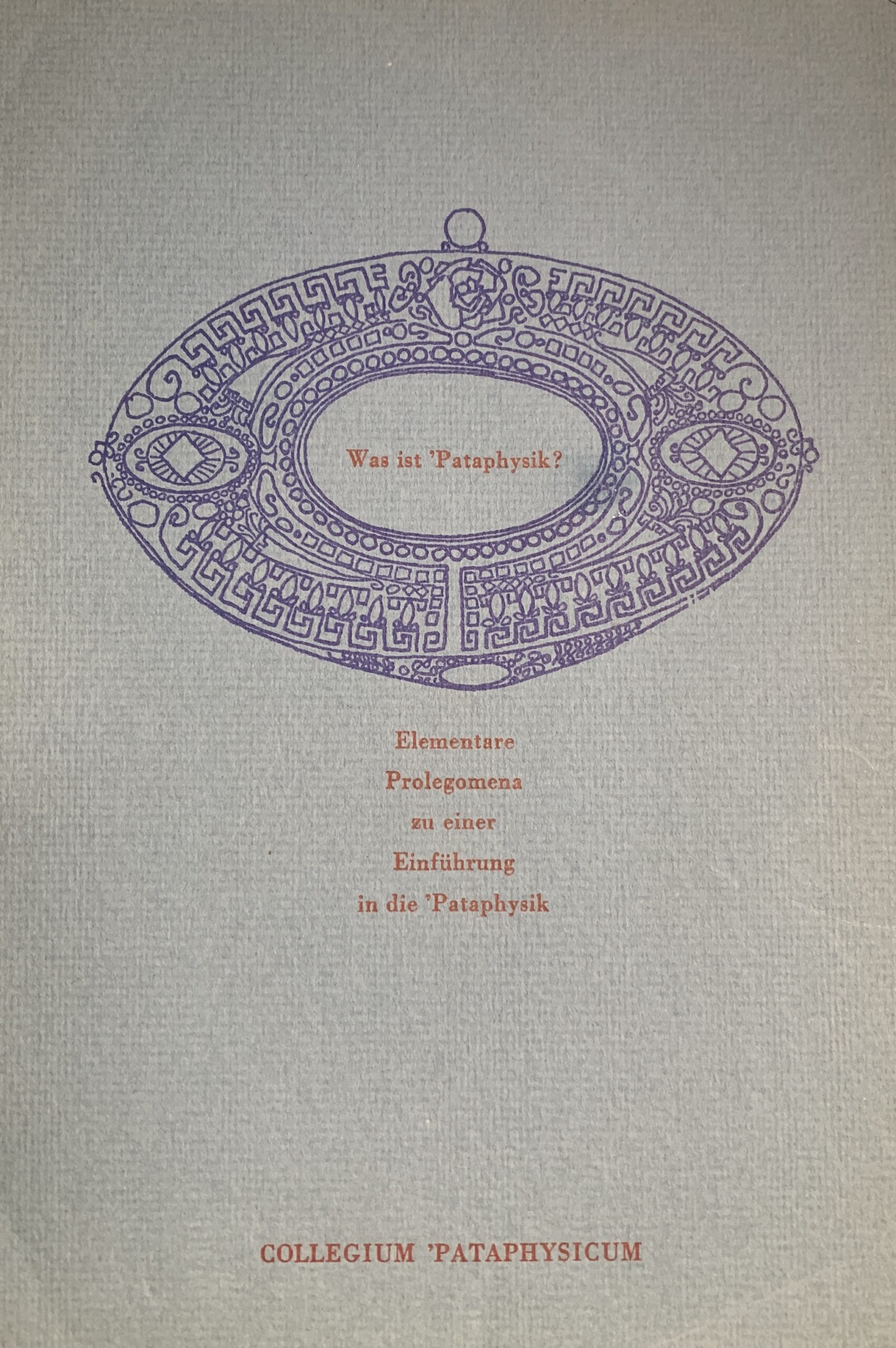
Was ist Pataphysik?, 1959 (vulg.) — Alfred Jarry / Collège de ‘Pataphysique
The answer to its own question. One of 444 numbered copies, with original ticket. Pataphysics as the science of the particular and of imaginary solutions. The College’s own definition of its own enterprise.
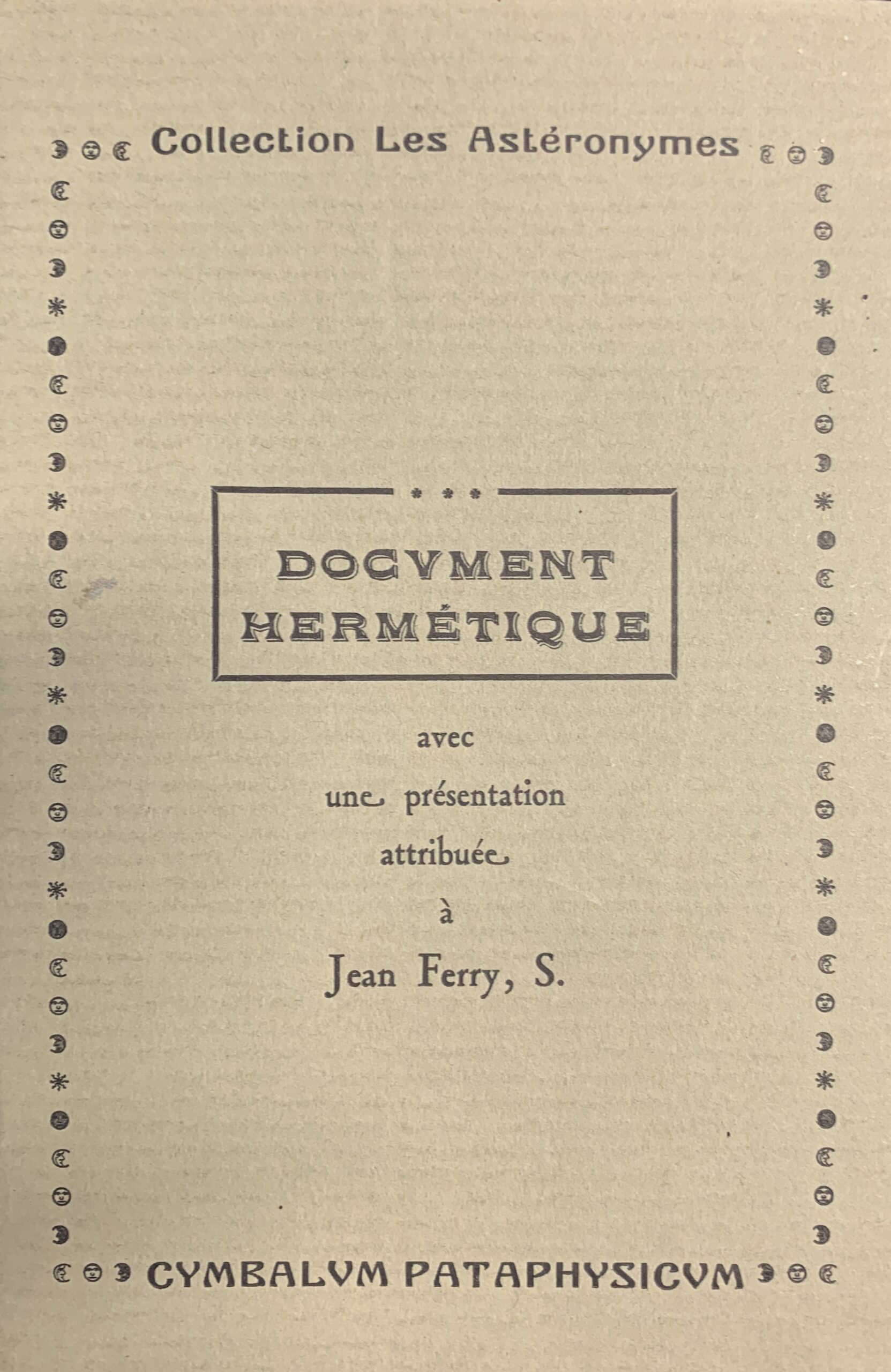
Document Hermétique avec une Présentation Attribuée à Jean Ferry. Collection Les Astéronymes Nr. 1, 1974 (vulg.) — Jean Ferry / Le Collège de Pataphysique
A diary entry of no significance and therefore, by the College’s working logic, of great importance. Pataphysique not as flourish but as taxonomy. Significance treated as a category that admits its own inverse without contradiction. The methodological core.
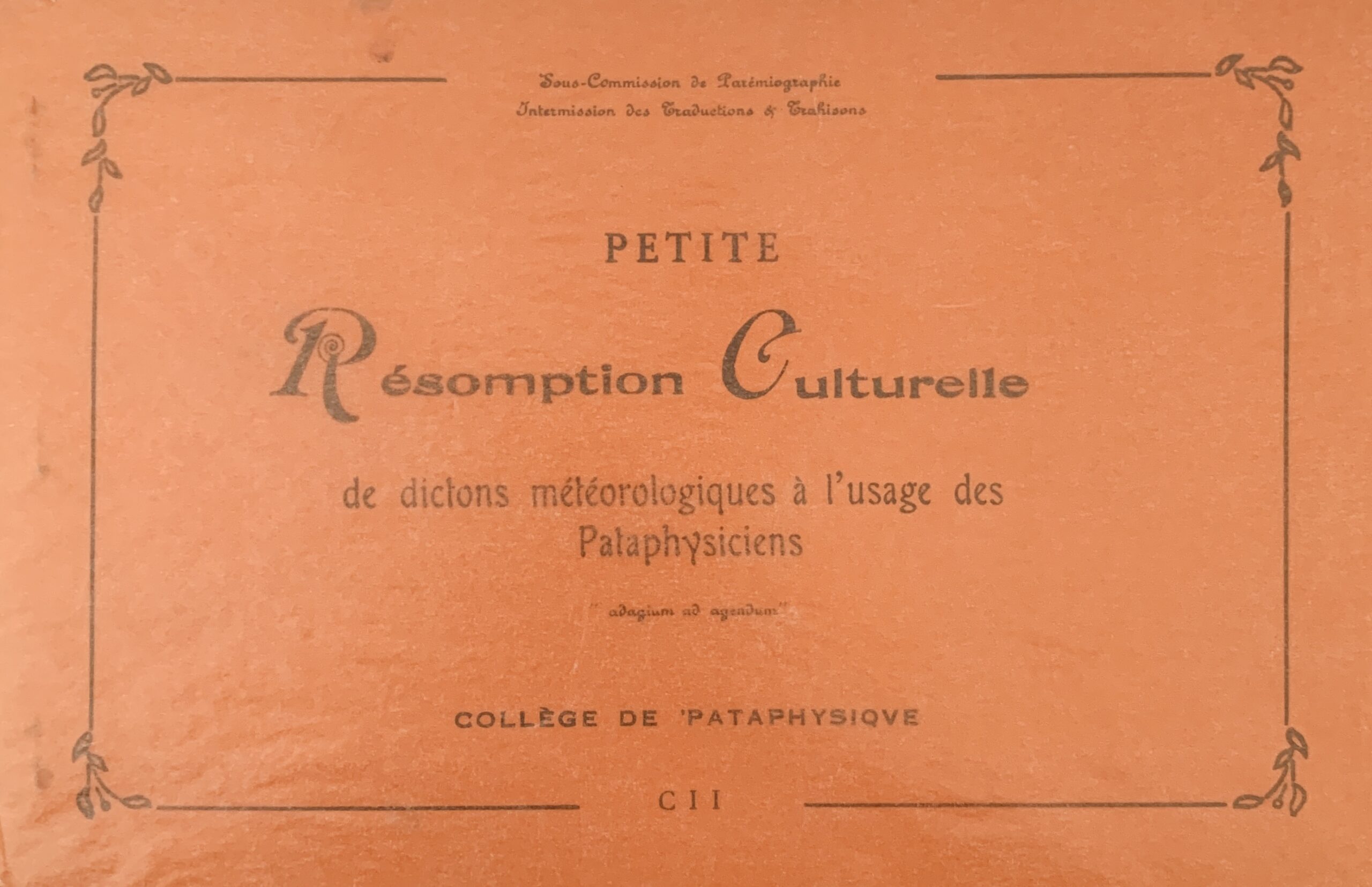
Petite Résomption Culturelle de Dictons Météorologiques à l’Usage des Pataphysiciens, 1973 (vulg.) — Collège de ‘Pataphysique
A 24-page treatise on a calendar based on Jarry’s death-date and an imaginary folklore. One of 333 superior copies from a total edition of 999. Imaginary methodology producing entirely real artefacts; a working calendar that belongs to no clock the world recognises.
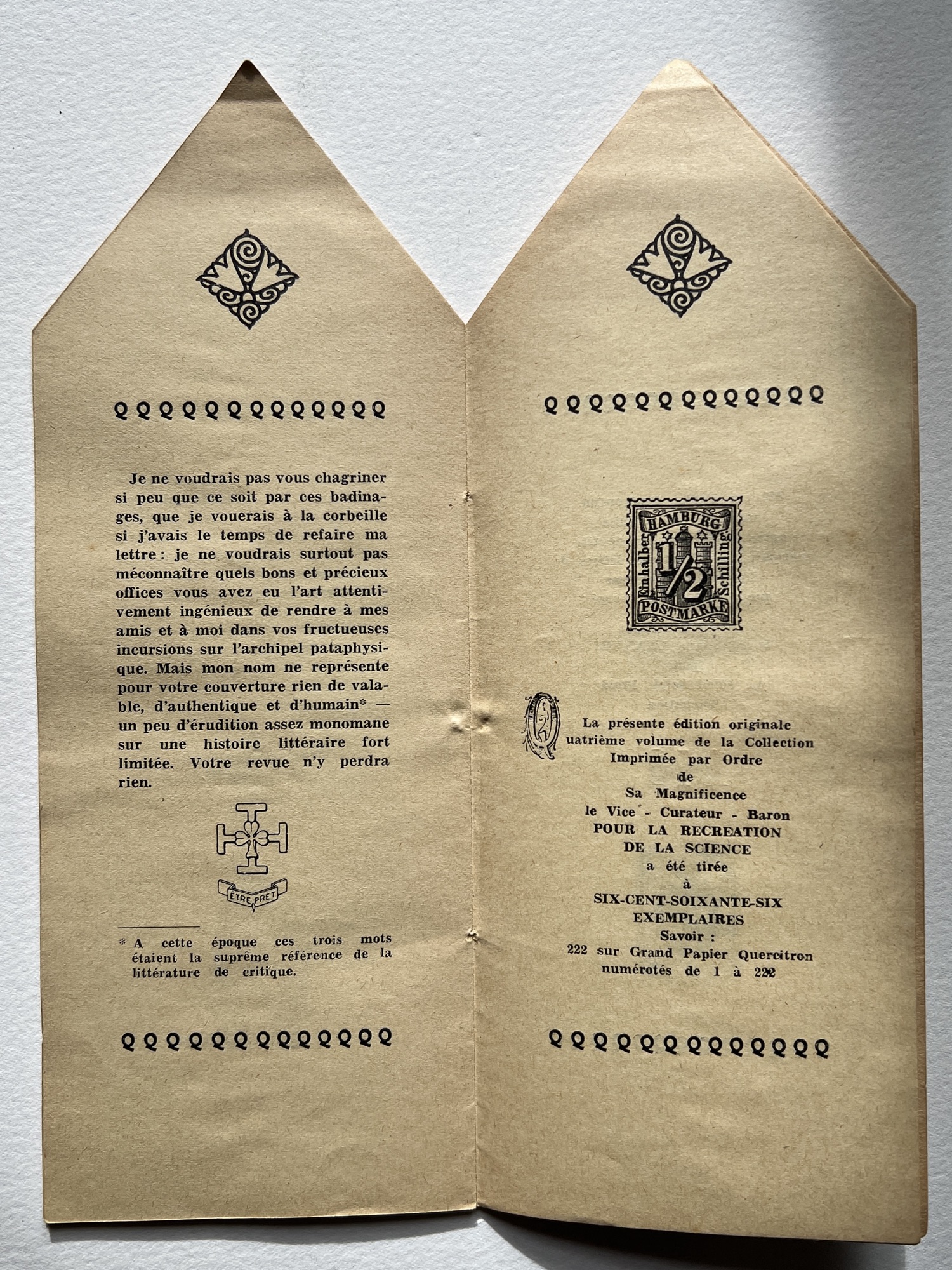
De Quelques Conséquences, 1961 (vulg.) — Jean-Hugues Sainmont
Founder of the College, in obelisk-shaped pamphlet, one of 666 numbered copies. Sainmont (whose real identity is itself a pataphysical question) argues from inside the College’s working assumptions. The genre proves itself by performance.
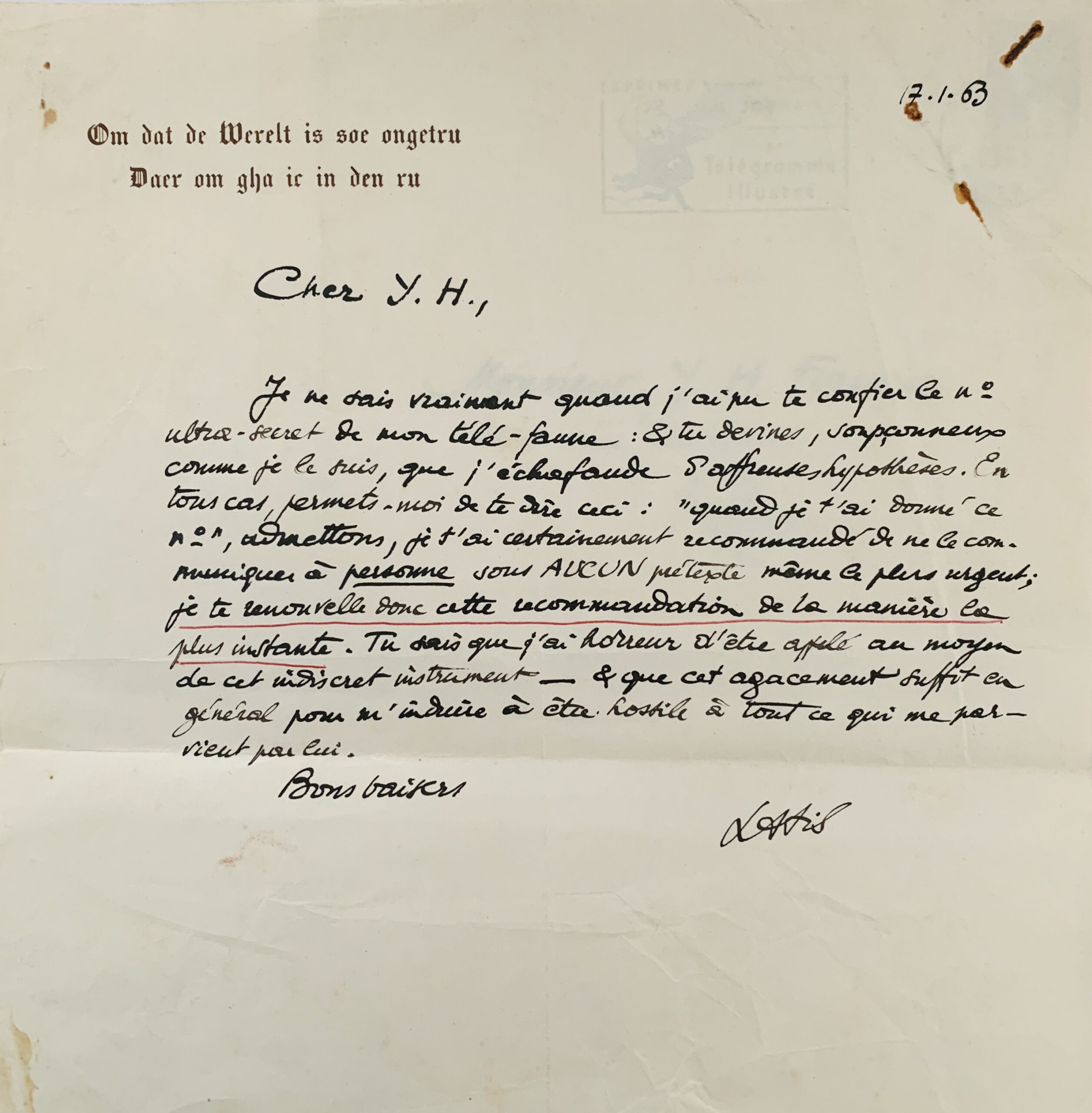
Pataphysical Letter and Retraction, 1963 — T.S. Latis / Yani Faux
An angry letter and its retraction, exchanged between members on the College’s stationery. The College conducting actual correspondence in pataphysical register. Administrative reality and imaginary methodology held simultaneously.
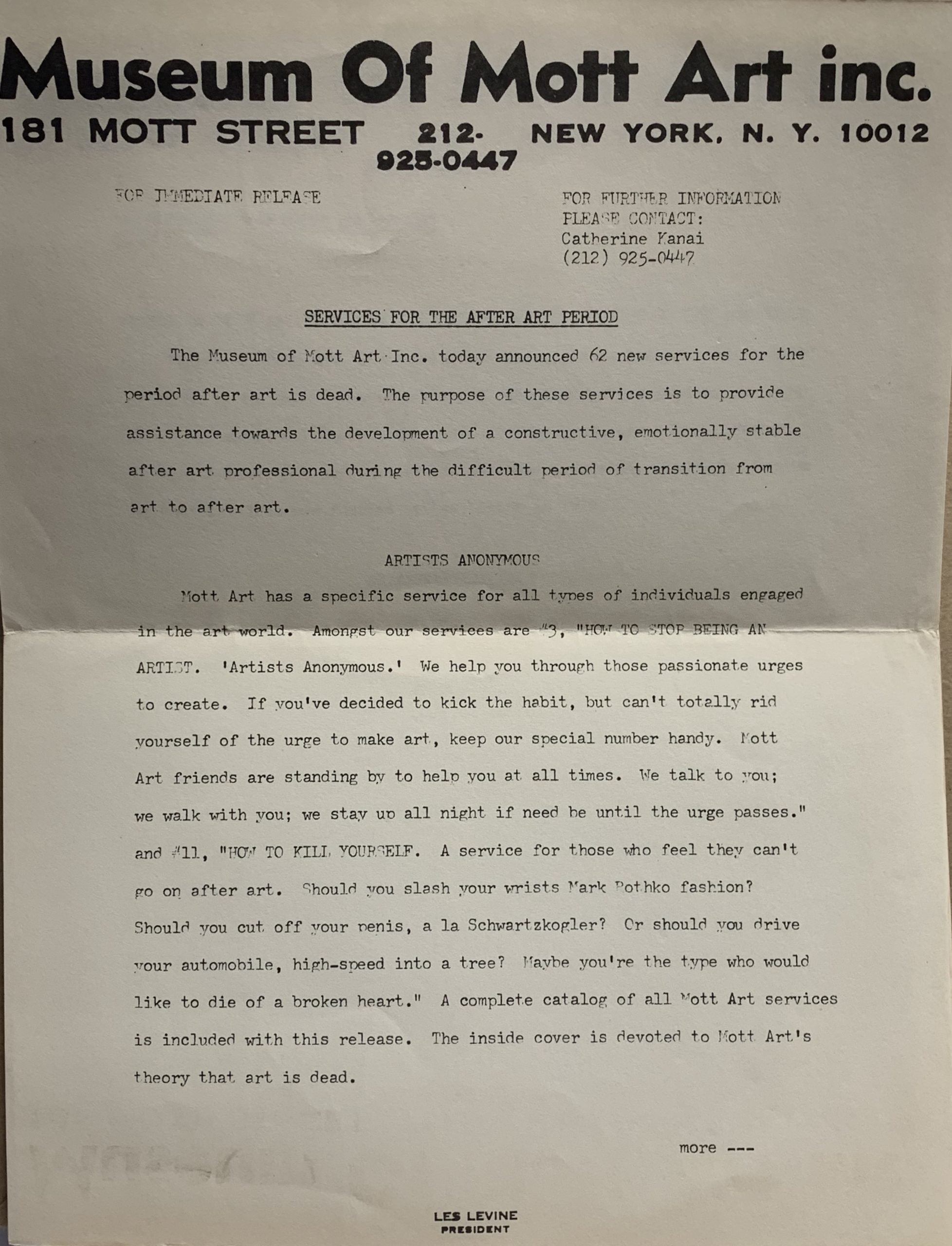
Services for the After Art Services, 1974 — Les Levine / Mott Art
Levine’s 62 new services for the period after art is dead — a press release offering services for a market that does not exist, or perhaps exists more truly than the one that does. Conducting commerce within the imaginary post-art world. A pataphysical economy in two pages of A4.